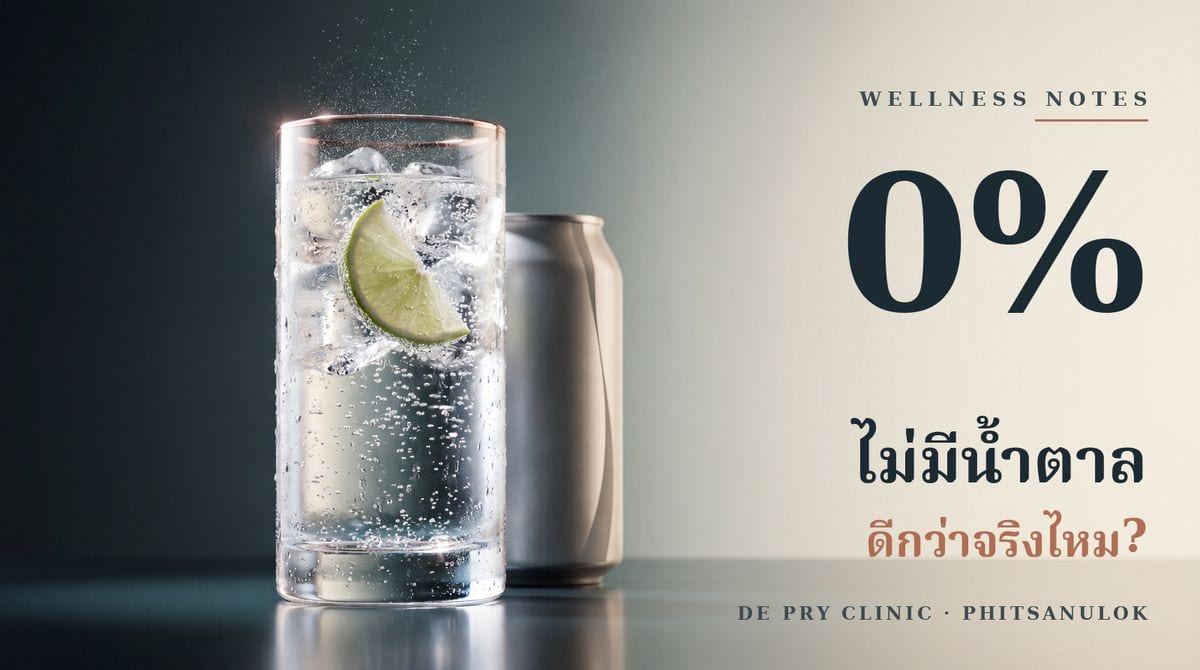
- Did you see the "artificial sweeteners cause cancer" news and glance at the can in your hand?
- Why does each authority say something different about the same thing?
- Start with the truth: what happens in your body with 1 can of regular soda
- Flip the 0% can over — what's hiding inside
- Sweeteners: not all of them are the same
- So does it make you fat or thin? The most debated angle of all
- Caffeine, fizz, and acid — the things many people overlook
- Who the doctor especially wants to be careful
- So if you want something fizzy, what should you drink?
- Managing weight and sugar with a doctor's care, in Phitsanulok
- Frequently Asked Questions
- References and Verification
Did you see the "artificial sweeteners cause cancer" news and glance at the can in your hand?
I understand this feeling well. Lately, headlines along the lines of "artificial sweeteners may cause cancer" have been everywhere. Many people who recently switched from sugary soda to the 0% kind with good intentions suddenly start to wonder, "Wait — am I just trading one bad thing for another bad thing?"
I'd like you to set that worry aside for a moment. In this article, I won't decide for you whether you "can drink it" or "must not drink it," because the truth of this matter really does have many sides — and the person who can make the best decision for your body is you, once you understand the full picture. My job is to lay out every side for you — both the reassuring parts and the parts to watch out for — and to think through it together with you.
0% soda is clearly better than sugary soda in terms of calories and sugar — but "better" does not mean "has no effect at all." Inside there are still artificial sweeteners, caffeine, gas, and acid, which each person tolerates differently. This article will help you choose which kind suits your own body, based on evidence rather than fear.
Why does each authority say something different about the same thing?
Got questions? Dr. Time offers personalized, honest consultations — no upselling.
Consult Dr. TimeIf you've ever been confused why "this doctor says it's fine, but another news piece says it's dangerous" — you're not imagining it. Even world-class health agencies genuinely don't agree on artificial sweeteners. And once you understand "why they say different things," you'll be able to read health news with lifelong immunity — not just on the topic of soda.
The key: "hazard" and "risk" are not the same word
Think of sharks. A shark is certainly an animal that is a "hazard," but if you're sitting on land, the "risk" of being bitten by a shark is zero — because real risk also depends on "how much you're exposed to it." Artificial sweeteners work exactly the same way — the question isn't just "is this substance hazardous," but "at the amount people actually drink, how risky is it?"
This is why, in 2023, the World Health Organization (WHO) issued announcements that sounded contradictory on the same day: the cancer research agency (IARC) classified aspartame in the group "possibly carcinogenic to humans" (Group 2B), which sounds "scary" — but on that very same day, the food safety committee (JECFA) said "the acceptable daily intake stays the same, no change needed." These two statements aren't actually contradictory — the first speaks about "hazard in theory," the latter about "risk in real life."
It means "there's some evidence, but not yet strong enough to conclude it causes cancer." Other things in this same group include aloe vera extract and pickled vegetables. Being placed in Group 2B therefore does not mean "proven to cause cancer," the way headlines like to make it sound.
ADI: the line authorities use to judge "how much counts as too much"
ADI stands for the amount that can be safely consumed daily over a lifetime. For aspartame it's 40 milligrams per kilogram of body weight. That sounds like a dry number, but let's translate it into a real picture: a person weighing 70 kilograms would have to drink roughly 9 to 14 cans of 0% soda per day, every day, to reach this line — which almost no one does.
And here is the point I find important: both the U.S. Food and Drug Administration (FDA) and the European Food Safety Authority (EFSA) also confirm in agreement that aspartame is safe at the amounts ordinary people consume. So you can see that the "disagreement" in the news is, in reality, everyone agreeing on the same thing — "don't drink too much" — they just emphasize different points.
| Agency | What it addresses | The gist |
|---|---|---|
| IARC (WHO cancer research unit) | Theoretical hazard | Aspartame = Group 2B "possibly carcinogenic," evidence still limited |
| JECFA (WHO food safety) | Real-life risk | Kept ADI at 40 mg/kg — moderate drinking is still safe |
| WHO (2023 guideline) | Weight control | Does not recommend using sweeteners for long-term "weight loss" |
| US FDA / EFSA | Approval for use | Safe at normal consumption levels, allowed |
Start with the truth: what happens in your body with 1 can of regular soda
Before comparing whether 0% is better, we need to understand what's wrong with the "original" we're running away from. Let me describe the picture inside your body. When you drink one can of sugary soda, around 10 teaspoons of sugar rush into your bloodstream very fast. Your body panics and quickly releases insulin to deal with it. At first you feel a refreshing surge.
But once the sugar is swept down as fast as it rose, your blood sugar plummets, and you feel hungry, drained, and craving sweets again. This cycle is what many people call a Sugar Crash, and when it repeats every day, it's the path that leads to insulin resistance, excess weight, and diabetes in the long run.
When you see this picture, you immediately understand why switching to 0% is a good step — because it really does cut out "10 teaspoons of sugar" and "140 calories." For people with diabetes or those controlling their weight, this switch helps a lot in terms of the numbers. The remaining question is, "So what about the thing they put in place of the sugar — what is it?"
Flip the 0% can over — what's hiding inside
Many people think 0% soda is just "water and fizz without sugar," but that's not actually true. The fact that it can still be sweet and fizzy without sugar means something else must do the job instead. Flip the can over and read the label, and you'll always find these 4 main players.
- Sweeteners (artificial sugar) — the ones that make it sweet in place of sugar, and the star of all the drama
- Caffeine — especially in the cola group
- Carbon dioxide gas — the thing that makes it fizzy
- Flavoring acids — phosphoric acid in cola, or citric acid in fruit flavors
I'll walk you through them one by one and what there is to know about each, because once you understand the full picture, you'll be able to choose which kind of can suits your body and which kind your body should avoid.
Sweeteners: not all of them are the same
This is the point where I see people misunderstand most often. When we say "artificial sweeteners," we tend to lump them all into one mass, when in fact each one has a different form, origin, and effect on the body. Some come from plants, some are synthesized, and importantly, many brands "blend several together" for a smoother taste. Reading the label is therefore a skill that genuinely helps you.
Aspartame — the one in the news, but also the most studied
Aspartame is the one in the Group 2B news we discussed. What I'd like to add is that it's a sweetener that has been used and studied for many decades, with one of the largest bodies of safety data behind it. But there is one important exception group: patients with a genetic disorder called Phenylketonuria (PKU). These people's bodies cannot process an amino acid called Phenylalanine, which is in aspartame, so they must avoid it. This is why the labels of many 0% sodas carry a phenylketonuria warning.
Sucralose — the one new research is watching for gut effects
Sucralose is very sweet and heat-stable, so it's widely used. But the point to know is that it's the one with data showing it can disrupt the beneficial bacteria in the gut (gut microbiome) quite significantly. In 2022, there was a very interesting randomized controlled trial (RCT) from a research team at the Weizmann Institute, published in the journal Cell. They had healthy people consume different types of sweeteners and found that sucralose and saccharin could alter the gut microbiome enough to affect blood sugar control in some people — but only "some people," because the result depends on each individual's unique microbiome.
Acesulfame-K (Ace-K) — the one to be careful with during pregnancy
Acesulfame-K is often blended with others to mask bitterness. The point to know is that some research suggests it may affect the gut microbiome, and importantly it can cross the placenta and pass into breast milk. Pregnant or breastfeeding women should therefore be especially careful.
Stevia — the one usually seen as the friendliest
Of all of them, stevia usually scores best in researchers' eyes, because it's extracted from a plant, disrupts the gut microbiome less, and rarely shows data about triggering inflammation. If you have a choice, looking for a brand that uses stevia as its main sweetener can be a more reassuring path.
In 2023, a study in the journal Nature Medicine found that high blood levels of erythritol (a sugar-alcohol-type sweetener) were associated with increased risk of heart attack and stroke, and in the lab it was found that it may make platelets clump into clots more easily. This is still early-stage research that needs further study, and erythritol is found more in "keto" desserts or sachet-type sweeteners than in typical 0% soda — but it's a good reason to "read the label" every time.
| Sweetener | Origin | What to know | Who should be careful |
|---|---|---|---|
| Stevia | Extracted from a plant | Disrupts the gut least, usually seen as the friendliest | — |
| Aspartame | Synthetic | Long-standing safety data, in Group 2B | PKU patients |
| Sucralose | Synthesized from sugar | Has fairly significant data on disrupting the gut microbiome | People with sensitive guts/controlling blood sugar |
| Acesulfame-K (Ace-K) | Synthetic | Can cross the placenta and into breast milk | Pregnant/breastfeeding women |
| Erythritol | Sugar alcohol | New research links it to heart risk (still needs further study) | People at risk of heart/vascular disease |
So does it make you fat or thin? The most debated angle of all
If a patient came to me with this question, I'd answer honestly: "No one can say for certain yet." And this is the angle the medical field debates most heavily, because the data really is confusing.
On one side: by the numbers, 0% soda has almost no calories and works well as a sugar substitute. But on the other side: several observational studies have found that people who drink a lot of 0% soda have higher risks of obesity, diabetes, and heart disease. Sounds contradictory, doesn't it? The key lies in the term reverse causality — people who are already obese or diabetic tend to be the group that "chooses" to drink the 0% kind more than the general population. So the soda may not be the cause; rather, it's the at-risk group choosing to drink it.
But there are also 2 mechanisms that researchers note "may" genuinely make weight harder to control:
- Sweet taste fools the brain — the tongue tastes sweetness, the brain prepares to receive energy, but the energy never actually comes. Some people then feel hungrier or crave sweets more afterward.
- Disrupting sweet-taste receptors in the gut — which may affect the body's blood sugar control, as gut research is beginning to show.
This is why, in 2023, the World Health Organization issued a recommendation that "sweeteners are not recommended for long-term weight control" — but I'd like you to note that it's a "conditional" recommendation, which means the evidence is not yet fully rock-solid. WHO did not say "it's dangerous, don't drink it," but rather "don't count on it as a weight-loss tool, because it's not a shortcut."
0% soda doesn't make you thin on its own, and it doesn't directly make you fat on its own. It's just "a drink that's better than sweets," not "a weight-loss tool." What truly determines your weight is the overall picture of your eating throughout the day.
Caffeine, fizz, and acid — the things many people overlook
When we talk about 0% soda, people tend to focus on artificial sweeteners and forget there are 3 other things in the can that can affect the body — and sometimes these are what hit you before the artificial sweeteners even do.
Caffeine — the one that disturbs sleep and the hearts of sensitive people
Many sodas, especially the cola group, contain about 30-40 milligrams of caffeine per can. Not as much as coffee, but for people sensitive to caffeine, even this is enough to cause insomnia, palpitations, anxiety, or to trigger acid reflux. And what many forget is that "children" also get caffeine from soda, even though they don't drink coffee.
Carbon dioxide gas — the fizz that bothers some people's stomachs
That refreshing fizz can, for some people, cause bloating, a full feeling, or trigger symptoms of irritable bowel syndrome (IBS) and worsen acid reflux. If you're someone who bloats easily, try observing yourself.
Acid — a matter of teeth, kidneys, and bones
Acid is something I find important but rarely discussed. Cola sodas usually use phosphoric acid, while fruit flavors usually use citric acid. This difference genuinely matters: phosphoric acid has been linked to kidney disease risk more so, especially in patients with chronic kidney disease stages 3-5 or those on dialysis, because this form of phosphorus is absorbed into the body almost 100%. Research has found that regularly drinking cola is associated with increased kidney disease risk, while drinks using citric acid show no clear such association.
As for bones, there's an interesting study called the Framingham Osteoporosis Study, which found that "cola" (which contains phosphoric acid) is associated with lower bone density in older women. But what's notable is that non-cola sodas showed no such link. And the caffeine in soda is not present in amounts high enough to be a primary cause of osteoporosis. Regardless of the acid type, both can erode tooth enamel, especially for people who like to "sip all day," because the teeth soak in acid longer than when you drink it all at once.
Sipping soda (including the 0% kind) little by little all day long harms teeth more than drinking it all at once, because the teeth soak in acid for longer. If you're going to drink it, drink it in finished sittings, then rinse your mouth or drink plain water afterward to help.
Who the doctor especially wants to be careful
One truth I'd like you to remember is that "safe for most people" does not mean "safe for everyone." Each person's body is different — some can drink it comfortably, some should talk to a doctor first. Let me lay it out clearly like this.
Can drink in moderation (general public)
- Healthy people who use it in place of sugary soda
- People controlling weight/diabetes who need to cut sugar (but not as a replacement for plain water)
- People who drink occasionally, not every day
Should consult a doctor/be careful first
- Children and teenagers (may develop a sweet-taste habit + get unnecessary caffeine)
- Pregnant and breastfeeding women
- People with acid reflux or irritable bowel syndrome (IBS)
- Patients with chronic kidney disease or a history of stones
- People who have insomnia, anxiety, or palpitations easily
- PKU patients (must avoid aspartame)
So if you want something fizzy, what should you drink?
At this point, I think the real question isn't "regular soda vs. 0% — which wins," because looking at the big picture, both still lose to simpler options anyway. I'd like you to see it as a "ladder" you can gradually climb at your own pace — no need to jump all at once.
- The first one to escape: sugary soda — the one that gives a full 10 teaspoons of sugar
- A better step (the bridge): 0% soda — cuts sugar and calories, but still has sweeteners, caffeine, and acid. Use it as a "bridge" to quit sugar, not as the destination
- A step lighter on the body: soda water / sparkling water — you get the fizz, no sugar, no artificial sweetener, no caffeine, just mild carbonic acid that erodes teeth far less. You can add lime or fresh fruit for flavor
- The best destination (and the cheapest): plain water — the thing your body truly needs
- 0% soda is better than the sugary kind, genuinely, but it's a "bridge," not the "destination"
- If you're going to drink it, drink as little as possible, no more than 1 can a day regularly, and don't use it as a replacement for plain water
- Want fizz with peace of mind → plain soda/sparkling water; want the best for your body → plain water
Managing weight and sugar with a doctor's care, in Phitsanulok
I've told you this whole story about soda not to make you afraid of eating, but because "sugar and metabolism" is the root of many things patients come to consult me about — from weight that's hard to lose, to fatigue, all the way to skin. If you feel you've been trying your best to take care of yourself but still aren't getting anywhere, sometimes having someone help you see the whole picture can change a lot.
At Depry Clinic, Phitsanulok, Dr. Time looks after weight and metabolism as a real physician — taking your history, assessing risk, and planning together with you — not just handing over products and being done. Many patients travel from Phichit, Sukhothai, Uttaradit, Kamphaeng Phet, and Phetchabun because they want care where "a doctor actually sits down and talks with them" close to home. If you'd like to start taking care of this with understanding, I'm glad to listen and help plan it out together.
Frequently Asked Questions
Does 0% soda make you fat?
There's no clear conclusion yet. It has almost no calories, so if you use it in place of sugary soda it genuinely helps reduce sugar and calories. But some observational studies have found that heavy drinkers are more overweight, which is partly reverse causality (people already worried about their weight choose to drink 0%). In short, it doesn't make you thin on its own — the overall picture of your eating throughout the day matters most.
Do the artificial sweeteners in 0% soda really cause cancer?
In 2023, WHO classified aspartame in the "possibly carcinogenic" group (2B), which means the evidence is not yet strong enough to conclude, and on the same day it kept the acceptable daily intake unchanged — a 70 kg person would have to drink around 9-14 cans per day, every day, to exceed the threshold. Moderate drinking has no evidence of directly causing cancer.
Is drinking one can of 0% soda a day dangerous?
For a normally healthy person, 1 can a day is at a level where most research still finds no clear harm. The key is "drinking it in place of sugar, not in addition to plain water." Seeing it as an occasional treat is better than as an everyday drink.
Can pregnant or breastfeeding women drink it?
It can be drunk occasionally in small amounts, but be careful, because caffeine and some sweeteners such as acesulfame-K can cross the placenta and into breast milk. The most reassuring option is plain water or plain soda, and if unsure, consult the obstetrician caring for your pregnancy.
Can people with kidney disease or stones drink it?
If you must drink it, avoid the cola type, because phosphoric acid is absorbed almost 100% and is linked to kidney disease risk, especially chronic kidney disease stages 3-5 or those on dialysis. Choosing a non-cola type carries less kidney-related risk, but you should still drink as little as possible and talk to the doctor caring for you first.
Which sweetener is the safest?
Stevia is usually seen as the friendliest, because it comes from a plant and disrupts the gut microbiome less. Next is aspartame, which has long-standing safety data. Sucralose has fairly significant data on disrupting the gut. Many brands blend several together, so reading the label helps you choose what fits your own body better.
Are soda water or sparkling water really better than 0% soda?
For someone who just wants the fizz, yes, they're better, because there's no sugar, no artificial sweetener, no caffeine, and no added phosphoric/citric acid — just mild carbonic acid that erodes teeth far less. But the best and cheapest thing for your body is still ordinary plain water.
I've heard erythritol is dangerous for the heart — is that true?
In 2023, a study in Nature Medicine found that high blood levels of erythritol were associated with increased cardiovascular risk and may trigger platelet clumping — a signal worth watching. But it's still early-stage research, and erythritol is found more in keto desserts or sachet-type sweeteners than in typical 0% soda. Reading the label helps you know which one you're getting.
References and Verification
I'd like you to be able to verify the information I used to write this article yourself — just click to read the originals:
- World Health Organization (WHO) — 2023 announcement on the aspartame assessment results (Group 2B but kept ADI at 40 mg/kg, with the example of 9-14 cans/day): who.int
- World Health Organization (WHO) — 2023 recommendation that sweeteners should not be used for weight control (a conditional recommendation): who.int
- U.S. Food and Drug Administration (U.S. FDA) — position that aspartame and other sweeteners are safe at normal consumption levels: fda.gov
- European Food Safety Authority (EFSA) — safety assessment and ADI of aspartame: efsa.europa.eu
- PubMed — Suez et al., journal Cell (2022) — randomized trial finding that sucralose/saccharin alter the gut microbiome enough to affect blood sugar control in some people: pubmed.ncbi.nlm.nih.gov
- PubMed — journal Nature Medicine (2023) — study linking high blood erythritol to cardiovascular risk: pubmed.ncbi.nlm.nih.gov
- PubMed — Framingham Osteoporosis Study — cola (not other sodas) associated with low bone density in older women: pubmed.ncbi.nlm.nih.gov
- Harvard T.H. Chan School of Public Health — a balanced perspective on sweeteners and why plain water is still the best option: nutritionsource.hsph.harvard.edu
Written by
ดร.นพ.ณธธรรมภ์ โอภาอภิณัฐฏ์ (หมอธามน์)Clinic physician at de Pry Clinic, Phitsanulok · Thai medical license no. 56524