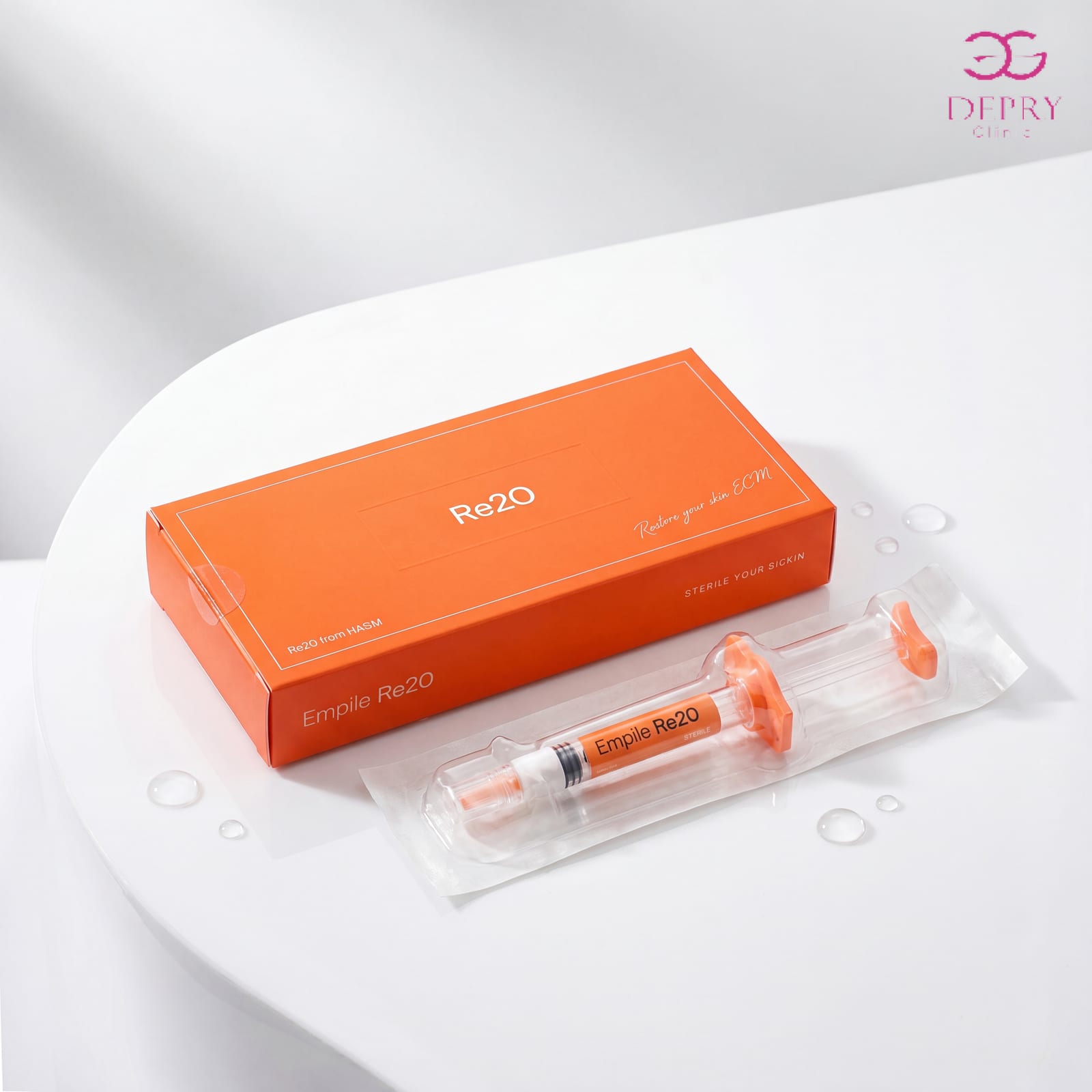
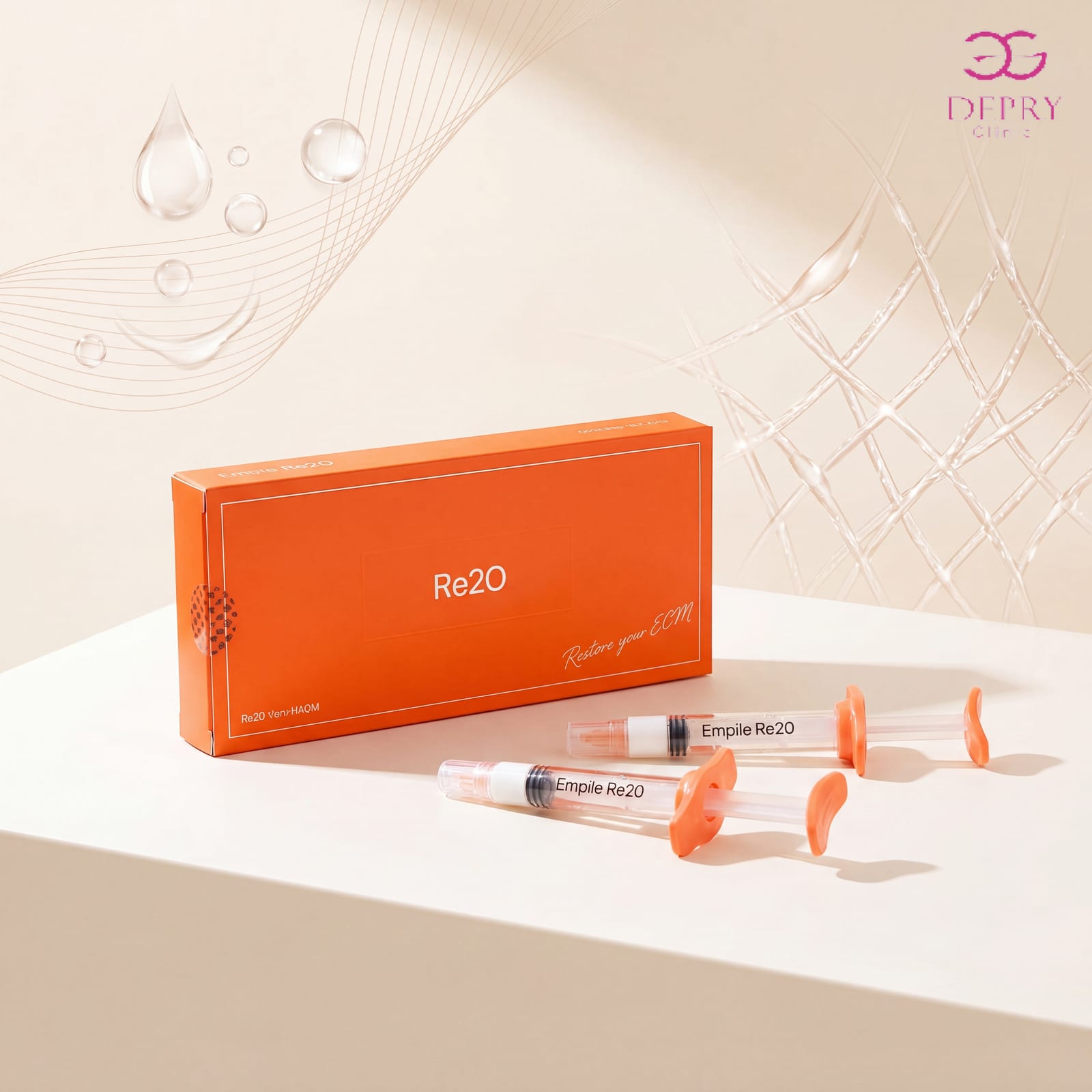
- What is Re2O? Why is it called "rebuilding skin from its structure"
- How Re2O works — how the ECM scaffold wakes the skin up to make its own collagen
- How is Re2O different from an HA filler? (rebuilding vs. adding water)
- Is there research behind it? I read through it for you
- When you see results, and how long they last
- Who Re2O suits, and who should consult first
- Consult about Re2O in Phitsanulok — de Pry Clinic
- Frequently asked questions
- References and verification
Re2O is a skin booster made from the skin scaffold (ECM) of human tissue that has had all of its cells removed, manufactured by L&C Bio of Korea. What sets it apart from ordinary HA fillers is that it doesn't just "add water" to plump the skin temporarily — it acts as a "scaffold" that lets your skin build its own new collagen. The result is therefore progressive (assessed over weeks to months) rather than an instant change. In this article, Dr. Time will walk you through what it is, how it works, where it differs from the things you already know, and the thing many people worry about — that it is "made from human tissue" — in a straightforward way.
What is Re2O? Why is it called "rebuilding skin from its structure"
"Doctor, my skin is starting to look thin and isn't as firm as before. When I add water it stays dewy for only a few months and then goes right back. Is there anything that genuinely brings firmness back?" — I hear questions along these lines very often in the consultation chair. And when I bring up Re2O, the next question is usually, "Oh, so it's just another kind of filler, right?"
I completely understand the confusion, because there are so many products on the market it gets dizzying. But I'd like us to understand it together step by step, because Re2O genuinely works on a different principle from the fillers we're familiar with — and that is exactly why I wanted to write this article for you to read.
Re2O is an injectable skin booster made from something called an acellular dermal matrix (ADM), or "the skin scaffold with its cells removed." To picture it simply: skin tissue is taken and all of its "cells" are washed away, leaving behind only the "lattice scaffold" of the skin — the part scientists call the extracellular matrix, or ECM, which is like the framework that keeps our skin firm, elastic, and structured. This scaffold is then micronized finely enough to pass through a needle. It is manufactured by L&C Bio of Korea.
So what does the phrase "rebuilding skin from its structure" that I use in the title mean? It means that, instead of placing some substance into the skin to make it look plumper for a while and then waiting for it to dissolve, Re2O lays down a "scaffold" for your own skin cells to attach to, get to work, and build new collagen. The improved skin is therefore skin you genuinely built yourself — not something borrowed and placed there temporarily. This is the heart of what makes it different from a water-filling filler.
Water-filling filler = "putting something into the skin" · Re2O = "laying down a scaffold so the skin builds its own" — this difference is the whole story. I'll keep expanding on it for you below.
How Re2O works — how the ECM scaffold wakes the skin up to make its own collagen
Got questions? Dr. Time offers personalized, honest consultations — no upselling.
Consult Dr. TimeWhen many people hear the phrase "stimulating collagen," they may think it's just pretty marketing. So I'd like to tell you what really happens in our skin, in a way you don't need to be a doctor to understand.
Imagine our skin is like a house. The "skin-building cells" called fibroblasts are the construction workers, while collagen and the ECM are the framework and walls of the house. As we age or as the skin deteriorates, the framework sags and the workers slow down, so the skin looks thin, lax, and not firm. What Re2O does is place a "ready-made framework" (the ECM scaffold) into the skin so the fibroblast workers have something to hold onto and a signal that prompts them to get busy again.
Once the ECM scaffold is in the skin, it does several things in sequence. Let me lay them out in order so you can picture it.
- Laying down the scaffold — the ECM framework becomes a lattice for skin cells to attach to and move through
- Calling the workers in — fibroblasts move into the scaffold, along with signals from growth factors that prompt the cells to work
- Building new blood vessels — angiogenesis occurs, meaning new capillaries arrive to nourish the area, making it more alive
- Building new collagen — the fibroblasts begin producing our own collagen (neocollagenesis), so the skin gradually becomes firmer and more structured
You can see this isn't a matter of "adding" something and being done. It's about "sparking" our own skin's repair-and-build process back into action. This is why its effect is progressive — because building new collagen takes time, like building a house where you have to wait for the concrete to set, not just place furniture inside.
Re2O = ECM scaffold → draws fibroblasts in to work → stimulates growth factors and new blood vessels → the skin builds its own new collagen. The result is improved "skin quality" from within, not volume that you add and then wait to dissolve.
How is Re2O different from an HA filler? (rebuilding vs. adding water)
This is the question patients ask me most often, because many have done a water-filling (HA) skin booster before and loved the "dewy glow" it gave — but quietly regretted that after a few months their skin went right back. Let me explain the difference in plain terms.
An HA (hyaluronic acid (HA)) skin booster works by "holding water" — it draws water into the skin, making it look dewy, hydrated, and bouncy at first, which is wonderful for people who want radiant skin quickly. But as the HA gradually breaks down naturally, the skin returns to its original state, because it is "adding," not "repairing."
Re2O works differently — it doesn't focus on holding water, but on laying down a scaffold so the skin builds its own collagen. The result is therefore a change in the "quality of the skin tissue" from within, such as density, elasticity, and firmness, rather than a surface dewy glow. Let me summarize it in a table so it's clear.
| Topic | HA filler / skin booster (adding water) | Re2O — ECM / ADM (rebuilding) |
|---|---|---|
| Working principle | Holds water, adds moisture into the skin | Lays down an ECM scaffold so the skin builds its own collagen |
| What changes | Dewy glow, bounce, hydration | Density, elasticity, and firmness of the skin tissue |
| How results appear | Fairly fast in the early phase | Progressive over time (weeks–months) |
| When the substance wears off | Skin returns to its original state | The newly built collagen is your own |
| Best for | Wanting dewy, glowing skin quickly | Wanting to restore skin structure and quality long term |
I want to stress that neither one is "better" across the board — it depends on each person's goal. If you want a quick dewy glow before an event, HA fits the bill. But if your goal is to restore skin that is becoming thin and lax back to firmness from its structure, Re2O is the more interesting approach. The key is to let a doctor help assess what your skin truly needs.
Is there research behind it? I read through it for you
When I get to this point, many of you are probably thinking, "It sounds good, but is there real evidence, or is it just pretty marketing?" — that's a very good question. Honestly, I'd want you to ask this about every procedure you're going to have done on your own face. Before recommending anything to a patient, I sat down and read through the research myself rather than taking the sales rep's word for it.
The first interesting study is a split-face comparison that was randomized and blinded on both sides, injecting a finely micronized ADM into one side of the face and HA into the other side of the same person, then following the results out to 20 weeks. The outcome was that the ADM side outperformed the HA side in several areas — skin density, volume, elasticity, wrinkle depth, pore size, hydration, and the skin barrier — with no serious side effects found throughout the follow-up.
Another is a multicenter randomized trial (multicenter RCT) using a finely micronized ADM injected to correct the nasolabial folds compared with a collagen filler. It found that at 6 months the efficacy was non-inferior; only in the early phase, the ADM might involve slightly more swelling and pain, which is manageable.
ADM has been used in medicine for a long time, but using it as an injectable skin booster for aesthetics is still fairly new. There is therefore less research than for HA or ordinary fillers, which have accumulated data over a long time. I'd want you to be aware of this fact too, so you can decide based on the full picture — not just the cosmetic side.
When you see results, and how long they last
This point is very important, because people who have had fillers before may expect to see a change right before their eyes the moment it's injected. I'd like to align expectations here first so no one is disappointed.
Re2O is not a volume fill that you see change from the day of injection — it gradually rejuvenates the skin over time, because what's happening is our body building new collagen, which takes time. In research, results are usually assessed at the following points.
That means you'll gradually feel your skin becoming firmer and the skin tissue improving week by week — not instantly on the first day. And because the result is our own collagen, it lasts for several months. I actually see this as an advantage — because the improved skin is genuinely yours, built by you, not something waiting to dissolve.
- The effect is "progressive," not a change on the first day
- It's usually assessed at 6 weeks / 3 months / 6 months
- Results last for several months, because the collagen is one we built ourselves
Who Re2O suits, and who should consult first
Now to the question patients usually ask me last — "So, is this right for me?" I can't answer that across the board, because it requires looking at the actual skin and each person's goals. But I can lay out a broad framework to give you the picture.
Suitable for
- People who feel their skin is becoming thin, lax, and no longer firm
- Dull, tired skin lacking radiance from its structure
- Enlarged pores, shallow fine lines
- Wanting to restore skin quality from within rather than temporarily adding water
Should consult a doctor first
- Currently pregnant or breastfeeding
- An infection/inflammation at the injection site
- An immune disorder or a blood-clotting abnormality
- A past allergy to injectable materials or a history of keloid scarring
I want you to feel at ease that consulting first is not a scary formal step, but the time when I get to look at your skin for real, hear what concerns you, and tell you straight whether Re2O suits you or whether there's another option that fits better. Good care always begins with understanding the person in front of you first.
Consult about Re2O in Phitsanulok — de Pry Clinic
If you're in Phitsanulok or a nearby province and are interested in rejuvenating your skin with Re2O but aren't sure yet whether it suits you, I'd like you to drop by for a chat first. At de Pry Clinic, Dr. Time personally assesses your skin and looks after every case himself. Many patients travel to see me from Phichit, Sukhothai, Uttaradit, Kamphaeng Phet, and Phetchabun because they want someone who will genuinely explain things to them before they decide — not just sell.
I'm someone with a great deal of experience in skin care, and I'm committed to bringing new knowledge and techniques back to look after the people in our area, so you can receive good care without traveling far. I'd also like to put your mind at ease on one more point — I look after this clinic myself every day, and no matter how the results turn out, I'm right here to keep following up and caring for you, not finishing and then disappearing. Because I'm committed to caring for everyone who walks in the way I'd genuinely care for my own family.
If you'd like to know whether Re2O suits your skin, or you're still hesitating, just message Dr. Time. You can consult first with peace of mind — no pressure to buy a package — just come and talk first about what your skin truly needs.
Frequently asked questions
What is Re2O ECM Skin Booster?
Re2O is an injectable skin booster made from donated human skin tissue that has gone through a process to remove all of its cells, leaving behind only the "skin scaffold" (acellular dermal matrix, or ADM/ECM). It is manufactured by L&C Bio of Korea, then micronized finely enough to be injected. What sets it apart from ordinary water-filling fillers is that it doesn't just add moisture — it acts as a scaffold that lets your skin build its own new collagen (neocollagenesis).
How is Re2O different from an HA (water-filling) filler?
The difference is in the core principle. An HA filler "adds water" into the skin, making it look plump and hydrated temporarily; once the substance breaks down, the skin returns to how it was. Re2O instead "lays down a scaffold" — an ECM that lets your skin-building cells (fibroblasts) move in and produce new collagen. It rebuilds the skin's structure rather than simply adding water. In a split-face comparison study, the ADM side outperformed the HA side at 20 weeks across skin density, elasticity, wrinkles, pores, and hydration.
When do you see results with Re2O, and how long do they last?
Re2O is not a change you see in terms of volume on the day of injection the way a filler is. It gradually rejuvenates the skin over time. In research, results are usually assessed at 6 weeks, 3 months, and 6 months, so the effect is progressive and lasts for several months — because what is being created is your own new collagen.
Re2O is made from human tissue — is it safe, or is it something to be afraid of?
I understand it can sound strange the first time you hear it. But ADM has been used in medicine for a long time. Tissue donors must first be screened negative for HBV, HCV, HIV, and syphilis. The tissue goes through decellularization and E-beam (electron beam) sterilization, there is a tissue-tracking system to trace its origin, and it must be injected by a doctor only. What remains is the ECM structure — not living cells from the donor.
How is Re2O prepared and injected?
Re2O comes as a powder of roughly 50 milligrams of ADM. The doctor mixes it with about 1.5–2.5 cc of sterile saline to form an injectable consistency, and it must be injected within roughly 4 hours after mixing. The injection is placed into the skin layer by a doctor. Because of this, preparation and injection must be done in a clinic that meets proper standards — it is not something you can buy and do yourself at home.
Who is Re2O suitable for?
It suits people who feel their skin is becoming thin, lax, and no longer firm, who have dull, tired-looking skin, enlarged pores, or shallow fine lines, and who want to restore skin quality from within rather than just temporarily adding water. People who are pregnant, breastfeeding, have an infection at the injection site, or have immune or blood-clotting disorders should always consult a doctor first.
Does Re2O have side effects?
Most are local reactions at the injection site, such as swelling, redness, tenderness, mild firmness of the skin, or temporary skin-color changes, which usually resolve on their own. In research, the early phase may involve slightly more swelling and pain than a collagen filler, but no serious side effects were found. Having a doctor assess you beforehand and follow up afterward makes it considerably safer.
Where can you get Re2O done in Phitsanulok?
At de Pry Clinic in Phitsanulok, Dr. Time personally assesses your skin and looks after every case himself, explaining whether Re2O is right for your skin and planning your care around your real goals. You can consult first with no pressure to buy a package.
References and verification
I'd like you to be able to check the information I used to write this article for yourself — just click to read the originals:
- PubMed (split-face study comparing hADM with HA) — a randomized, blinded study that found the ADM side restored density, elasticity, wrinkles, and hydration better than HA over 20 weeks: pubmed.ncbi.nlm.nih.gov
- PubMed Central (RCT injecting ADM to correct nasolabial folds) — a multicenter randomized trial that found finely micronized ADM was non-inferior to a collagen filler at 6 months: pmc.ncbi.nlm.nih.gov
- U.S. FDA — Tissue & Tissue Products — information on the regulation of human tissue, donor screening, and tissue safety standards: fda.gov
- Thai Food and Drug Administration (อย.) — the system for verifying health products, and the principle that injectable procedures must be performed by a doctor: oryor.com
Written by
ดร.นพ.ณธธรรมภ์ โอภาอภิณัฐฏ์ (หมอธามน์)Clinic physician at de Pry Clinic, Phitsanulok · Thai medical license no. 56524