- What is a weight-loss pen? Why did it suddenly become famous worldwide
- Timeline: From animal venom in America to the weight-loss drug the whole world is talking about
- How do these drugs work in our body? (You don't have to be a doctor to understand)
- Which brand is which drug? (Mounjaro, Wegovy, Ozempic, Saxenda)
- The "strange brands" you shouldn't touch — black-market drugs and unregistered peptides
- A real cautionary tale: the news of a clinic ordered closed for 15 days
- Side effects you need to know — and why "having a doctor in charge" changes everything
- What does Thai law say? Who can inject and who cannot
- At de Pry Clinic, we care for you as real "doctors"
- Consult about weight-loss medication in Phitsanulok — de Pry Clinic
- Frequently asked questions
- References and verification
A "weight-loss pen" is a drug in the GLP-1 group that started out as a diabetes medication in America 20 years ago, and was later developed into a weight-loss drug. Genuine, FDA-approved drugs such as Mounjaro and Wegovy are safe and genuinely effective when they are in a doctor's hands. What is dangerous is not the drug itself, but "unregistered black-market drugs" and "injections given by someone who is not a doctor, without assessment, without follow-up." In this article, Dr. Time will walk you through it from start to finish, in a way that anyone — even someone who knows nothing about it — can understand.
What is a weight-loss pen? Why did it suddenly become famous worldwide
Over the past couple of years, the phrase "weight-loss pen" has become something we hear almost every day. Some people see foreign celebrities slim down so fast it's startling; others see a friend holding a little pen that looks just like a writing pen, and wonder, "What exactly is that? Does injecting it really make you thin? Is it safe?"
I understand this curiosity well, because it's something new that arrived very quickly. Let me explain it in the simplest way first: a "weight-loss pen" is really an injection pen that contains a drug in a group called a GLP-1 receptor agonist (pronounced gee-el-pee-one). The pen itself is just a "device" that makes it easy and relatively painless to inject the drug under the skin. The real star is the "drug" inside it.
And the secret that many people don't know is this — this drug was not invented for beauty or slimness at all. It came into being to save the lives of people with "diabetes." Its story is fascinating, so let me take you back to the very beginning.
Timeline: From animal venom in America to the weight-loss drug the whole world is talking about
Got questions? Dr. Time offers personalized, honest consultations — no upselling.
Consult Dr. TimeTo understand just how safe weight-loss pens are, we first need to know "where they come from," because a drug with a long history that has been studied for decades is surely different from "some strange thing" that suddenly pops up for sale with no origin. Let me lay it out as a timeline so you can picture it.
A strange beginning: the venom of the "Gila monster" (2005)
Would you believe that the origin of this group of drugs comes from the saliva (venom) of the Gila monster, a large venomous lizard in the American desert? Scientists found that its saliva contained a substance called exendin-4 that helped control blood sugar over a long period, so they developed it into the first drug in this group, named Byetta (exenatide), approved by the U.S. FDA in 2005 to treat type 2 diabetes. At that time it still had to be injected twice a day, and no one was talking about weight loss yet.
A key step: a diabetes drug that "accidentally" caused weight loss (2010–2014)
In 2010, a new drug called Victoza (liraglutide) came out, injected just once a day, also used to treat diabetes. But doctors around the world began to notice one thing in common — diabetic patients using this drug were "clearly losing weight" without intending to.
That was the point at which the medical community began to think, "If it can make people this slim, why not develop it into a weight-loss drug outright?" So in 2014, the very same liraglutide was adjusted to a higher dose and released under a new name, Saxenda, becoming the first GLP-1 drug approved specifically for weight loss.
The boom era: Ozempic and Wegovy (2017–2021)
In 2017, a drug called Ozempic (semaglutide) came out. Its standout feature was injection just once a week, with excellent blood-sugar control, used to treat diabetes — and, as before, patients lost even more weight than with the older drugs.
So in 2021, the company took the same semaglutide, adjusted it to a higher dose, and released it under the name Wegovy directly for weight loss. Studies found it helped reduce weight by an average of around 15% of body weight over roughly 68 weeks, which was considered the most a drug had ever achieved at that time. This was the period when the "weight-loss pen" began trending worldwide.
The latest and most powerful: Mounjaro and Zepbound (2022–2023)
In 2022, a newer-generation drug called Mounjaro (tirzepatide) arrived, smarter still, because it acts in two ways at once (on both the GIP and GLP-1 hormones). It started out being used to treat diabetes, and then in 2023 the same drug was released under the name Zepbound for weight loss. Research found that some people lost more than 20% of their weight, making it the most powerful weight-loss drug currently available.
| Year | Brand name | Drug name | Started as | Highlight |
|---|---|---|---|---|
| 2005 | Byetta | exenatide | Diabetes | First in the group, from Gila monster venom |
| 2010 | Victoza | liraglutide | Diabetes | Once-daily injection; first signs it caused weight loss |
| 2014 | Saxenda | liraglutide | Weight loss | First GLP-1 directly for weight loss |
| 2017 | Ozempic | semaglutide | Diabetes | Once-weekly injection |
| 2021 | Wegovy | semaglutide | Weight loss | Average weight loss ~15% |
| 2022 | Mounjaro | tirzepatide | Diabetes | Dual action (GIP+GLP-1) |
| 2023 | Zepbound | tirzepatide | Weight loss | Most powerful, over 20% reduction |
This group of drugs "was born out of treating disease," not as a fashion toy. It has been studied in real patients for over a decade. That means the genuine, FDA-approved drugs are backed by safety data — as long as they are used correctly and with a doctor in charge.
How do these drugs work in our body? (You don't have to be a doctor to understand)
Let me explain it in plain, everyday terms. Normally, when we eat, our intestine releases a hormone called GLP-1. This hormone is like a "meal manager" that keeps telling the body, "You've eaten enough, you're full now." This group of drugs mimics this hormone so that it acts longer and stronger, doing three main things:
- Making you feel full quickly and stay full longer — the drug slows the squeezing of the stomach, so food stays in the stomach longer, meaning we don't get hungry as often and eat less without having to force ourselves.
- Sending signals to the brain — telling the hunger-control center in the brain to "reduce appetite." The thoughts about food that used to circle in your head all day become lighter.
- Helping control blood sugar — stimulating the body to release insulin only when blood sugar is high, and reducing the hormone that raises blood sugar, so it controls diabetes well at the same time.
Once you understand the mechanism, you'll see that this drug is not a "fat-burning drug" or a "water pill" as many people mistakenly think. It's about helping us "eat less naturally," which is why it's effective and fairly more sustainable than the old-style weight-loss drugs that work by stimulating the nervous system and causing palpitations.
Which brand is which drug? (Mounjaro, Wegovy, Ozempic, Saxenda)
This is where a lot of people get confused, because there are so many brand names. Let me sum it up simply: a "brand" and the "drug" are two different things, like soft drinks that come in many brands but where some are actually the same flavor.
| Drug (real name) | Brand for diabetes | Brand for weight loss | Manufacturer |
|---|---|---|---|
| semaglutide | Ozempic | Wegovy | Novo Nordisk |
| tirzepatide | Mounjaro | Zepbound | Eli Lilly |
| liraglutide | Victoza | Saxenda | Novo Nordisk |
You can see that Ozempic and Wegovy are really the same drug, semaglutide. They differ in "dosage" and the "indications" they are registered for. The same goes for Mounjaro and Zepbound, which are the same tirzepatide. This is why choosing the drug must be considered by a doctor, not chosen by the brand a friend recommended — because what suits your friend may not suit your body and underlying conditions.
The "strange brands" you shouldn't touch — black-market drugs and unregistered peptides
Now we come to the part I'm most concerned about, and the heart of what I want everyone to read to the end.
Once the genuine drugs became famous and expensive, "imitations" and "strange things" began flooding the market. Let me clearly break down how many types there are and why they're dangerous.
- Self-mixed drugs / split-dose injections (compounded) — abroad, during drug shortages, some pharmacies mixed powdered substances into injectable drugs themselves. The U.S. FDA warned that many used a different substance (a different salt), or sometimes contained no actual drug at all.
- "Research peptides" — sold online, labeled "for research only / not for human use," as powders or vials for you to mix with water and inject yourself, with no control over cleanliness or quantity whatsoever.
- Brands not in the FDA system — such as NOVOTRIMPLUS and VitaPeptix in the news, which sound like real drug names but in fact cannot be found in the FDA registry at all.
I actually checked for real on the website oryor.com of the Food and Drug Administration (FDA) itself, and the result was clear:
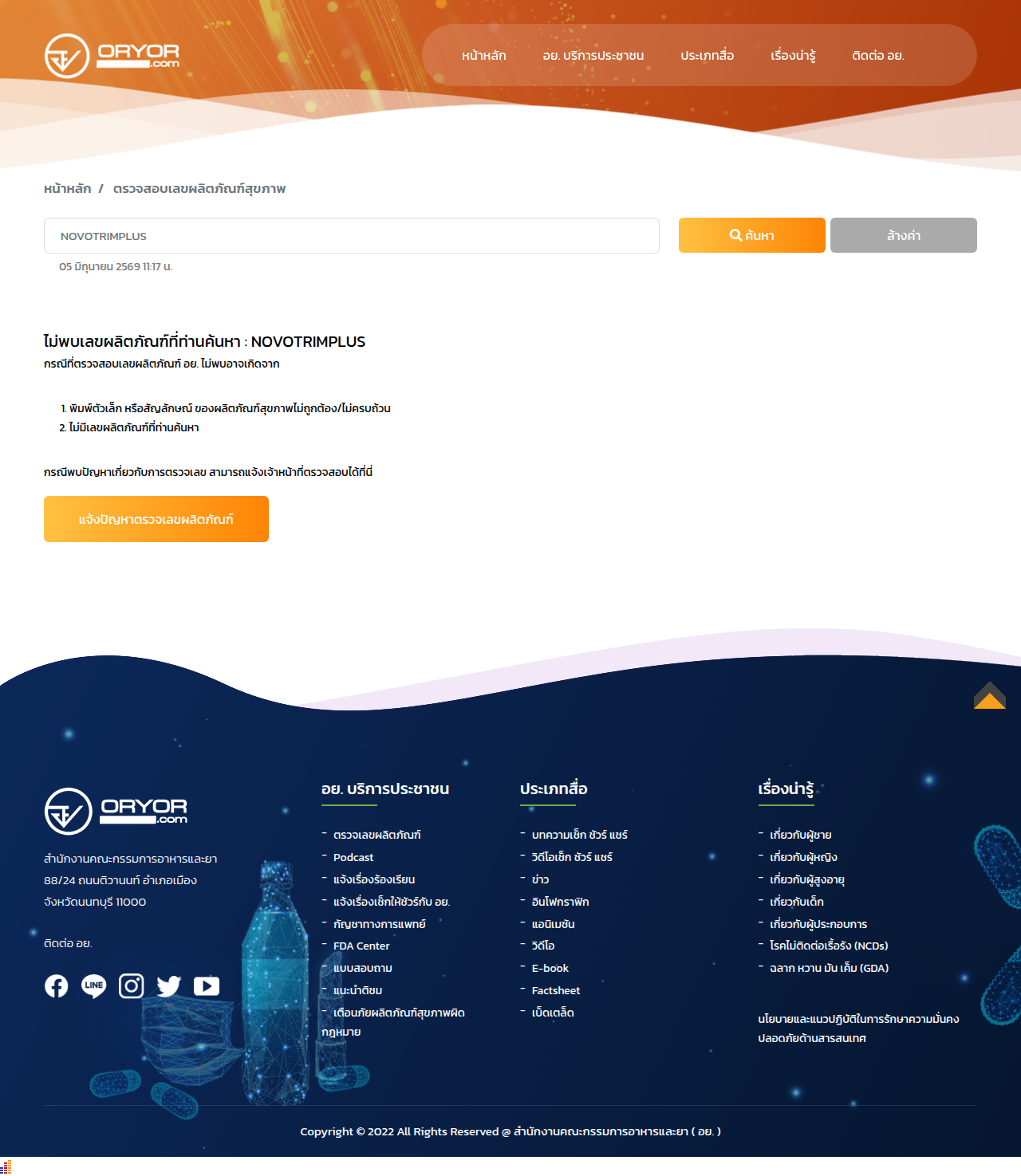
Searching for NOVOTRIMPLUS in the FDA system — the result is "no records found"

Searching for VitaPeptix in the FDA system — the result is likewise "no records found"
On the contrary, when you search for genuine drugs like Mounjaro and Wegovy, you find complete information — a registration number and a properly authorized importing company:

Searching for Mounjaro — 13 records found, properly registered (Zuellig Pharma)
Because no one certifies what is inside the vial, how much active drug it contains, or whether it's clean and sterile. The possible outcomes are overdosing to the point of severe low blood sugar, bloodstream infection, severe allergic reaction (anaphylaxis), or no effect at all, after which the patient increases the dose themselves. And importantly, when symptoms arise, we cannot trace the source of the drug at all, making it much harder to fix — both in a clinic and when bought to self-inject at home. These things should never be used, under any circumstances.
A real cautionary tale: the news of a clinic ordered closed for 15 days
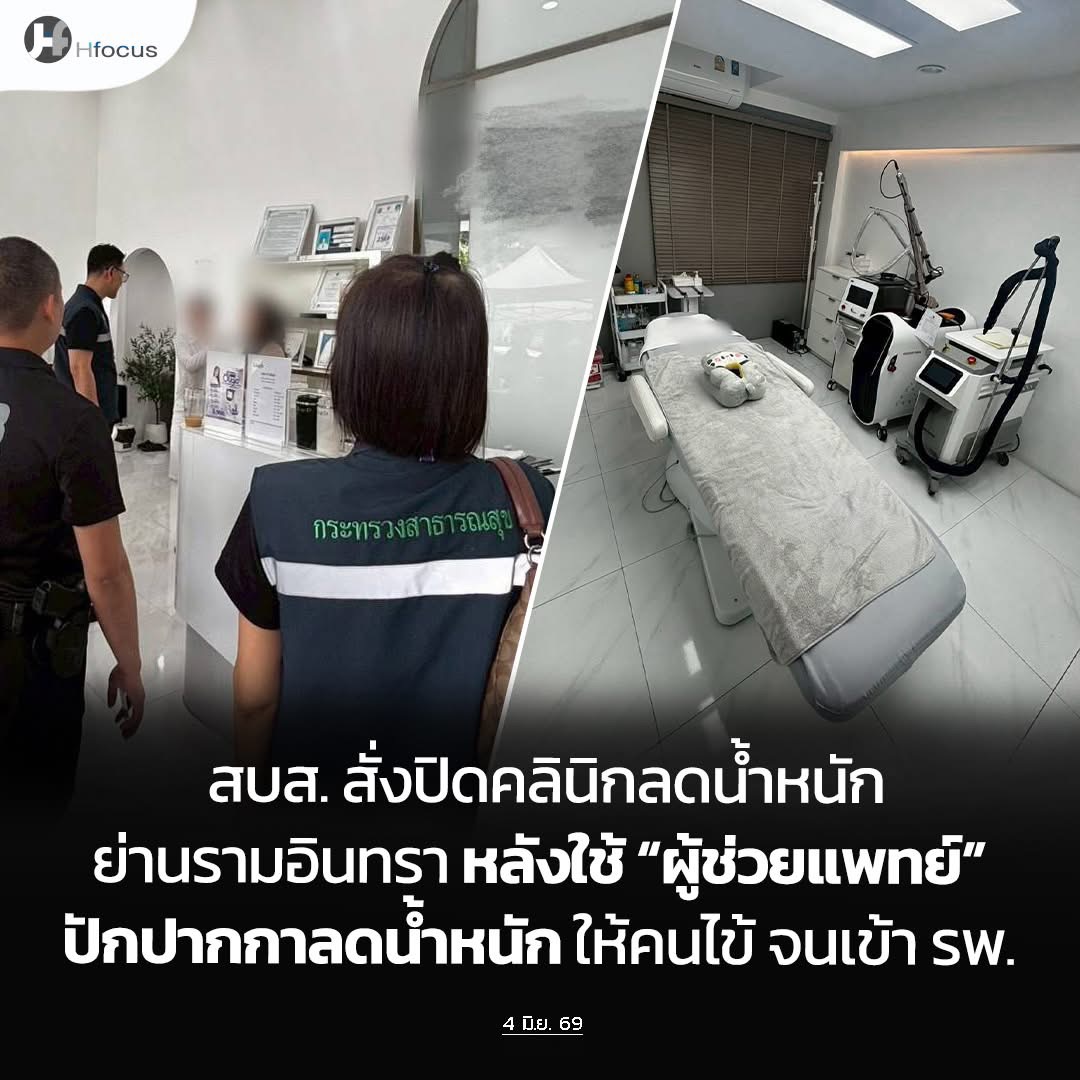
I believe many of you have seen this news and felt your heart sink too — in early June 2026, the Department of Health Service Support (HSS) ordered a weight-loss clinic in the Ram Inthra area closed for 15 days after finding that a "medical assistant" had been administering weight-loss pen injections to patients, until a patient had to be hospitalized (citing news from Hfocus / TNews).
This became widely known because the husband of the victim decided to come forward and tell the story himself — not to attack anyone, but because he didn't want other families to have to sit watching their loved one on a hospital bed the way he did. When I read it, I truly understood the heart of someone who is a family member.

A post from the victim's husband who came forward to tell the story himself, to warn others not to go through the same thing — with respect for his family's courage, I share it as a cautionary lesson.
I'm not telling this story to make anyone afraid of losing weight, but so that we can learn from it, because what went wrong in this case was "entirely preventable." According to the victim's family's account and the agency's investigation, the problems happened in a chain like this:
- On the day of the visit, there was no doctor's examination — no medical history was taken, no assessment was done, no diagnosis was made, and no physical examination was done before the injection at all.
- The person who did the injection was not a doctor — they were an "assistant," even though by law they have no right to perform this procedure.
- There was a drug switch (upsell) — instead of getting the original drug requested, the patient was persuaded to switch to an in-house product "claimed to be similar with fewer side effects," which was later found to be a drug not registered with the FDA.
- The result was the patient was hospitalized — the family had to watch over their loved one with great anxiety.
Reading it, I truly ache for his family. And what I admire is that he didn't just post to vent, but properly submitted the case to every overseeing agency — the HSS, the FDA, the Medical Council, the Consumer Protection Board, and the police — so that a real investigation would take place. This is a fight to make others safer.

His family officially submitted the case to every relevant agency so that a serious investigation would be carried out.
Let me say it plainly — the problem is not that the "weight-loss pen" is something frightening, but rather "who is in charge" and "whether the real or the fake product is used." If a doctor assesses you first, uses an FDA-approved drug, and follows up on your symptoms, things like this would almost never happen.
Bad news like this is there for us to "stay aware," not for us to "be so afraid that we don't dare take care of ourselves." People who want to lose weight safely can always still do so — just choose the right place, the right people, and the right drug, and you'll be safe.
Side effects you need to know — and why "having a doctor in charge" changes everything
Every drug that works naturally has side effects, and the weight-loss pen is no exception. Let me tell it truthfully, without hiding anything, because knowing in advance is the best prevention.
Common symptoms (usually resolve on their own as the body adjusts)
- Nausea, bloating, feeling full quickly
- Diarrhea or constipation, especially during dose increases
- Fatigue, headache, loss of appetite in the early period
Symptoms to watch out for (uncommon, but important)
- Pancreatitis — severe, continuous abdominal pain that may radiate to the back; you must stop the drug and go to the hospital immediately.
- Low blood sugar — especially in people using it together with other diabetes medications.
- Worsening kidney function — usually caused by dehydration from severe vomiting/diarrhea.
- Risk of certain types of thyroid cancer — so it is prohibited in people with a history of medullary thyroid cancer or MEN2.
- Sudden blurred vision — a sign that is now being monitored abroad; if your vision is abnormal, see a doctor promptly.
This is exactly the reason I keep emphasizing that "there must be a doctor in charge," because a real doctor will screen for these contraindications before the injection — for example, asking about a history of pancreas problems, kidney disease, liver disease, and thyroid cancer — and if an emergency arises, the doctor can respond in time. Someone who is not a doctor has no way of knowing what to watch out for, and no way to help in time when something goes wrong.
What does Thai law say? Who can inject and who cannot
Many people may not know that there is a law protecting us on this matter. The FDA has issued a notification designating injectable GLP-1 drugs (weight-loss pens) as a "specially controlled drug," which means:
- They must be prescribed by a doctor only — you cannot buy and use them as you please. Diagnosing, choosing the drug, and determining the dose are the doctor's duty.
- The act of injecting can be done by a professional nurse under a doctor's order and supervision — but not by a "medical assistant" or general staff.
- The clinic must have a responsible doctor on duty — providing medical services without a doctor is a violation of the healthcare facility law and may constitute practicing medicine without a license.
Put simply, the law is designed to ensure that "the person who decides what drug goes into your body must be someone with enough knowledge to be responsible for your life." The case in the news therefore violated both the drug law and the healthcare facility law at the same time.
At de Pry Clinic, we care for you as real "doctors"
At this point, I want you to feel more at ease, because losing weight with this group of drugs "can be done safely" if it's in the right hands.
Dr. Time promises that here, treatment is not just "grab a pen, stick it in, and done," but caring for the whole person. Every case, I do myself, following the proper steps of being a real doctor:
- Taking your medical history — asking about underlying conditions, current medications, history of the pancreas, kidneys, thyroid, and your goals.
- Assessment and physical examination — seeing whether you genuinely have an indication, and whether there are any contraindications to avoid.
- Diagnosis and choosing the right drug — selecting the drug and dose that fit your body, not just whatever another place uses.
- Planning the dose titration — gradually, to minimize side effects as much as possible.
- Continuous follow-up — checking on your symptoms, adjusting the plan, and ready to care for you if anything is abnormal.
- Using only FDA-approved drugs, verifiable for every dose — showing you the drug box before the injection; you can check oryor.com right in front of me.
I once lost 16 kilograms myself, so I understand the heart of someone who wants to be slim and safe at the same time. I don't want anyone's beauty to come at the cost of risk, and I will never allow anyone to harm my patients with substandard drugs or careless treatment.
Consult about weight-loss medication in Phitsanulok — de Pry Clinic
If you're in Phitsanulok or a nearby province and want to lose weight safely under the care of a real doctor, de Pry Clinic is glad to look after you. Here, Dr. Time assesses and cares for every case personally, uses only FDA-approved drugs, and is ready to answer all your questions so you can decide with peace of mind, with no pushy course sales.
If you'd like to start losing weight in a way where you don't have to be afraid, because a real doctor is with you every step of the way, message Dr. Time anytime. The consultation is free, with no charge.
Frequently asked questions
Is the weight-loss pen (GLP-1) really a diabetes drug? Why can it be used for weight loss?
Yes, it is. This group of drugs came into being to treat type 2 diabetes first. The very first was Byetta (exenatide), approved in America in 2005. While being used to treat diabetes, doctors noticed that patients also lost weight, because the drug slows down food digestion and sends signals to the brain to feel full quickly and stay full longer. It was later developed into drugs specifically for weight loss, such as Saxenda and Wegovy.
How do Mounjaro, Wegovy, Ozempic, and Saxenda differ?
They are different brands, but some are the same drug under different names: Ozempic and Wegovy are both semaglutide (Wegovy uses a higher dose for weight loss). Mounjaro is tirzepatide, which acts in two ways, and Saxenda is liraglutide given as a once-daily injection. Choosing the right one requires a doctor's assessment based on each person's body and underlying conditions.
Can a medical assistant or clinic staff member give weight-loss pen injections to patients?
No, they cannot. GLP-1 drugs are a "specially controlled drug" that must be prescribed by a doctor only. Diagnosing, choosing the drug, and determining the dose are the practice of medicine that must be done by a doctor. The act of injecting can be done by a professional nurse under a doctor's order, but a "medical assistant" or general staff member has no right to set up an injection service themselves — that is a violation of the healthcare facility law.
How dangerous are unregistered weight-loss "strange brands" such as NOVOTRIMPLUS and VitaPeptix?
Drugs not registered with the FDA have no certification of quality, safety, or active-drug quantity. They may contain contaminants, be non-sterile, have uncertain dosages, and no one knows what's truly inside. From the check on oryor.com, neither NOVOTRIMPLUS nor VitaPeptix was found in the FDA system, not even a single record, so they should not be used either in a clinic or in everyday life.
How can I check for myself whether the drug a clinic uses is genuinely FDA-approved?
Go to the oryor.com website of the Food and Drug Administration, choose the product-verification menu, and type the drug's name, such as Mounjaro or Wegovy. If a record appears, it's properly registered; if not, be cautious. It takes only 2 minutes, and a clinic that meets standards will always be glad to let you look at the drug box and check right in front of you.
What are the side effects of the weight-loss pen, and is it dangerous?
The most common are gastrointestinal symptoms such as nausea, bloating, diarrhea, or constipation during dose adjustment, which usually improve as the body adjusts. Those to watch out for are pancreatitis, low blood sugar, dehydration to the point of worsening kidney function, and sudden blurred vision. Severe symptoms are uncommon, and it becomes much safer when a doctor screens for contraindications and follows up on your symptoms.
Who is not suitable for, or should avoid, the weight-loss pen?
People with a history of pancreatitis, a history of medullary thyroid cancer or MEN2 syndrome, pregnant or breastfeeding women, those with severe kidney or liver disease, and people whose weight is already in the normal range. This drug is meant for those who genuinely have an indication, not something anyone can inject to be "slim and pretty" at will, so a doctor's assessment is always required first.
At de Pry Clinic Phitsanulok, how is the care different from "random injecting"?
Dr. Time cares for every case as a real doctor: taking your history, assessing risks, examining your body, diagnosing which drug suits you, planning the dose titration, and following up continuously, using only FDA-approved drugs verifiable for every dose. It's not just grab a pen, stick it in, and done — because treatment is caring for a person, not just giving an injection.
References and verification
I want you to be able to verify the information I use for yourself — here are the references this article draws on:
- Food and Drug Administration (FDA) — health-product verification system and drug registry: oryor.com
- U.S. Food and Drug Administration (FDA) — information on the approval of GLP-1 drugs (Byetta, Saxenda, Ozempic, Wegovy, Mounjaro, Zepbound): fda.gov
- Hfocus in-depth health-system reporting — news of the Department of Health Service Support ordering a weight-loss clinic closed for 15 days (June 2026): hfocus.org
- Department of Health Service Support (HSS), Ministry of Public Health — the Healthcare Facility Act and the regulation of specially controlled GLP-1 drugs
Written by
ดร.นพ.ณธธรรมภ์ โอภาอภิณัฐฏ์ (หมอธามน์)Clinic physician at de Pry Clinic, Phitsanulok · Thai medical license no. 56524