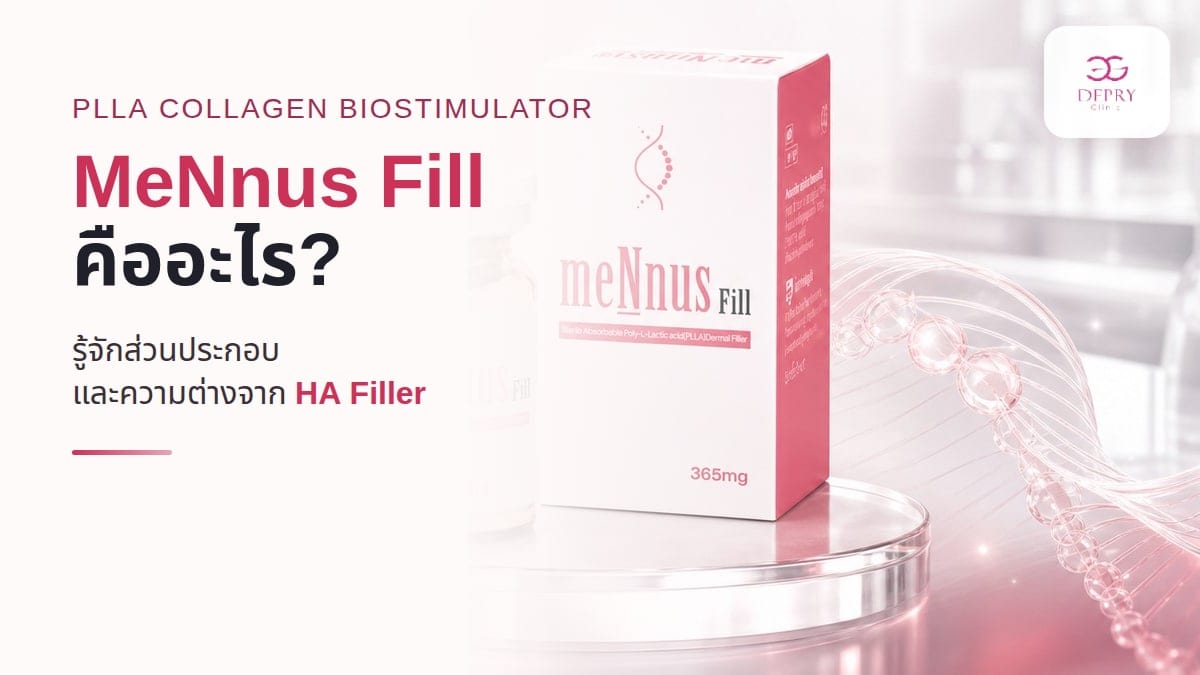

Fillers may look identical across all brands, but they actually differ right down to their internal structure—and the specific injection site determines which one should be used.
Many people believe that fillers are just 'dermal fillers' that are the same across all brands. In reality, fillers have two primary structures that produce completely different results—and a skilled doctor must select the right one for each specific injection site, rather than using a one-size-fits-all approach.
- What are Monophasic and Biphasic Fillers?
- What Problems Do Both Filler Types Solve?
- Who is it Suitable For? Who Should Avoid It?
- Monophasic vs Biphasic: What is the Difference?
- How Much Do They Cost? How Many CCs/Units are Used?
- How Many Days to See Results? How Long Do They Last?
- Does It Hurt? What are the Side Effects?
- How to Care for Yourself After the Procedure?
- Getting Fillers in Phitsanulok — Depry Clinic
- Frequently Asked Questions
Monophasic fillers consist of a smooth, fine gel that blends exceptionally well with the skin, making them perfect for delicate areas like the under-eyes or lips. On the other hand, Biphasic fillers contain gel particles that help lift the skin tissue and provide robust structure, making them ideal for areas requiring sharp definition such as the chin, temples, or deep nasolabial folds.
What are Monophasic and Biphasic Fillers?
When patients walk in and ask, "Doctor, why does this brand of filler look so smooth and natural, while another brand feels firm and holds its shape so sharply when touched?" I explain it simply like this: it all depends on the internal molecular structure, which is divided into two main types: Monophasic and Biphasic.
What is the Structure of a Monophasic Filler?
Imagine "fine, smooth glass noodles boiled until they merge into a single, soft texture." Monophasic filler is a hyaluronic acid (HA) gel that has a uniform density throughout the entire syringe, with no separate gel particles. The advantage is that it spreads easily, remains smooth, and does not form lumps under the skin, making it perfect for filling superficial skin layers.
What are the Special Properties of Biphasic Fillers?
For the Biphasic type, imagine "tiny pearls soaked in liquid jelly." It is a combination of semi-firm gel particles suspended in a liquid gel carrier that guides the injection. The key benefit is its excellent ability to support sagging skin, hold a beautiful shape, and withstand the pressure of facial muscles when we move our face.
Neither structure is 100% better than the other. It is just like choosing a paintbrush to paint the background versus using a pencil to draw sharp outlines. For areas that require softness and seamless blending, we use a single-phase texture (Monophasic). For areas that need clear structure and lift, we use a particle-based texture (Biphasic).
What Problems Do Both Filler Types Solve?
Got questions? Dr. Time offers personalized, honest consultations — no upselling.
Consult Dr. TimeIf a patient is concerned about fine wrinkles or wants their lips to look plump and kissable, I will select one type of gel. However, if they want to contour their facial structure to add dimension—such as lengthening the chin or filling out the temples—I will use the other type to address their facial concerns as precisely as possible.
Why Do Doctors Recommend Smooth-Textured Fillers for Under-Eyes or Lips?
The under-eyes and lips are areas with very thin skin that are constantly in motion. If we use a particle-based (Biphasic) filler under the eyes, the skin might swell or show hard lumps when you smile or blink, which looks unnatural. Therefore, I choose Monophasic fillers with high elasticity that seamlessly blend into the skin layers for the most natural result.
- Monophasic (Smooth Gel): Ideal for smoothing fine wrinkles, rejuvenating dark and sunken under-eyes to make them look bright, and adding volume to the lips.
- Biphasic (Particle-Infused Gel): Ideal for filling hollow temples, correcting a short chin to create a slimmer V-shape face, lifting the mid-face/apple cheeks, and resolving deep nasolabial folds caused by bone resorption.
Who is it Suitable For? Who Should Avoid It?
I always evaluate each patient's facial structure and skin condition thoroughly before injecting, because skin layers and thickness vary greatly from person to person.
Which Patient Groups Should Postpone Their Treatment?
Even though filler injections are highly safe, if you belong to any of these groups, I recommend informing me beforehand or postponing your treatment for your own safety.
Who is Suitable for This Procedure
- Those concerned about deep folds, hollow cheeks, a short chin, or tired-looking under-eyes.
- Those who want to contour their face to add dimension and achieve a beautiful, natural look.
- Those who want to see visible facial improvements without undergoing major surgery.
Who Should Avoid or Postpone It
- Mothers who are currently pregnant or breastfeeding.
- Individuals with a history of severe allergic reactions to hyaluronic acid.
- Those with active inflammation, infection, or severe cystic acne at the intended injection site.
Monophasic vs Biphasic: What is the Difference?
To give patients a clear and easy-to-understand comparison before making a decision, I have summarized the key differences between the two filler types in this table below.
How Do They Feel to the Touch Post-Injection?
If you gently press the skin where the filler was injected after the gel has set, a Monophasic filler will feel soft, bouncy, and very similar to your actual skin, making it almost indistinguishable. On the other hand, a Biphasic filler will feel much firmer and offer more resistance to the touch, as it is designed to support the skin structure, acting much like a structural bone replacement.
| Property | Monophasic (Single-Phase Gel) | Biphasic (Particle-Infused Gel) |
|---|---|---|
| Texture | Fine, smooth, highly elastic, and blends well | Contains tiny gel particles with high springiness/lift |
| Distribution Under Skin | Spreads evenly, does not easily form lumps | Clumps together to hold shape sharply, does not migrate |
| Most Suitable Areas | Under-eyes, lips, superficial wrinkles | Chin, temples, mid-face/cheeks, deep nasolabial folds |
| Popular Brands in the Market | Juvederm (some models), Belotero (some models) | Restylane (some models), Neuramis (some models) |
How Much Do They Cost? How Many CCs are Used?
The price of filler injections depends on the brand, manufacturing country, and the actual number of CCs used for each area. Generally, I evaluate each patient's individual facial structure to determine the most suitable amount, ensuring it is neither too much nor too little.
Why Do Different Brands Cost Differently Even for the Same Amount?
This is because each brand uses its own patented cross-linking technology. Premium fillers from the US or Sweden undergo complex manufacturing processes, resulting in highly stable gels that last longer. I always select and recommend the most suitable option for your budget and target areas, ensuring you receive the best value and safety.
How Many Days to See Results? How Long Do They Last?
Why Do Particle-Based (Biphasic) Fillers Usually Dissolve Slower?
Because Biphasic fillers have a molecular structure composed of densely packed gel particles, it is harder for our body's natural enzymes to break them down compared to the soft, smooth, liquid-like gel of Monophasic fillers. However, the actual duration still heavily depends on each patient's lifestyle and aftercare.
- Immediately Post-Injection: You will notice a clear change in shape right away, although there may be minor needle marks and slight swelling or tightness from the anesthetic.
- Days 3-5: Swelling from the needle will visibly subside, and the gel will begin to soften and blend more naturally with the skin.
- Day 14: The filler will fully absorb water and settle into place perfectly, achieving its most beautiful and natural shape.
Does It Hurt? Are There Any Side Effects?
I completely understand that those deciding to get fillers for the first time usually worry most about pain and side effects.
What Kind of Post-Injection Swelling and Redness is Normal, and When Should You See a Doctor Immediately?
Minor swelling, redness, or bruising around the needle marks is a normal response after injections and will gradually fade on its own within 3–7 days. However, if you experience severe throbbing pain, if the skin around the injection site looks unusually pale or white, or if blisters or pustules develop, you must contact me immediately. At Depry Clinic, my team and I always closely monitor our patients' progress to ensure your peace of mind.
I would like to strongly warn you against smuggled or cheap counterfeit fillers advertised on the internet. These products are usually not approved by the FDA and do not dissolve naturally, leading to chronic inflammation, migration into unsightly lumps, or dense fibrotic tissue in the long run. These issues are extremely difficult to correct and highly dangerous.
How to Care for Yourself After the Procedure?
To ensure that the fillers we carefully inject achieve a beautiful shape and last as long as possible, your self-care routine after returning home is just as important as the procedure itself.
Is It True That Drinking Plenty of Water Helps the Filler Plump Up Beautifully?
It is absolutely true and highly important! Hyaluronic acid is exceptionally hydrophilic, meaning it binds water very well. Drinking 2–3 liters of clean water daily during the first 2 weeks post-injection will help the gel plump up to its full potential, resulting in a fuller, smoother, and longer-lasting shape.
- Avoid pressing, massaging, or squeezing the treated area to prevent the filler from shifting or losing its shape.
- Avoid exposure to high heat, such as saunas, facial lasers, or sitting close to hot mookata grills, during the first 2 weeks.
- Drink plenty of clean water every day to help maximize the water-binding capacity of the gel.
Getting Fillers in Phitsanulok — Depry Clinic
For anyone looking for a high-quality facial contouring and filler clinic in Phitsanulok, I would like to invite you to stop by for a consultation with me at Depry Clinic first.
Why Do Many Patients Drive Long Distances to See Dr. Time at Depry Clinic?
I am dedicated to bringing my knowledge, experience, and safe facial contouring techniques to care for people here, ensuring you receive top-tier treatment close to home without wasting time traveling all the way to Bangkok. Whether they are local residents or patients from nearby provinces like Phichit, Sukhothai, Uttaradit, Kamphaeng Phet, and Phetchabun, many trust me to answer their questions and contour their faces.
Most importantly, as the owner of the clinic, I honestly oversee every single case myself—from initial facial assessment, selecting the right filler type, mixing the product in front of you, verifying the authentic box codes together before opening, to scheduling follow-ups. No matter the outcome, I am always here to provide warm, continuous care and will never abandon my patients.
At Depry Clinic, we only use genuine fillers approved by the Thai FDA, and every single box can be fully verified. I will personally show you how to check for authenticity in detail before opening and injecting, ensuring your absolute confidence and peace of mind regarding safety.
Frequently Asked Questions
1. Which Hurts More During Injection, Monophasic or Biphasic Fillers?
The level of pain does not depend on the gel's structure, but rather on the injection site and the use of anesthetics. Most genuine fillers already contain integrated lidocaine (local anesthetic) inside the syringe, so you will only feel a slight tightness during the procedure.
2. If a Biphasic Filler Feels Too Hard After Injection, Can It Be Dissolved?
Yes, it can be dissolved. If it is a genuine hyaluronic acid (HA) filler, regardless of its structure, a dissolving agent (Hyaluronidase) can generally be injected to dissolve it (the outcome depends on the physician's medical discretion).
3. Can I Get Fillers and Botox Treatments at the Same Time?
Yes, they can be done together on the same day. I often plan Botox treatments to relax the muscles in combination with fillers to restore facial structure, achieving the softest and most natural-looking results.
4. For a First-Timer, Which Filler Structure Should I Choose?
I recommend choosing based primarily on the target area you want to treat. If you are concerned about your under-eyes or lips, starting with a soft, gentle Monophasic filler is ideal. If you are concerned about a short chin or deep nasolabial folds, a Biphasic filler is better for skin support. I will personally evaluate and select the most suitable type for you.
5. Will the Filler Migrate or Deform If I Accidentally Sleep on My Side Immediately After the Injection?
During the first 2-3 days, the filler is still settling into place. Therefore, I recommend avoiding putting heavy pressure on the area or sleeping on your side with your face pressed too hard against the pillow to prevent any unwanted migration or deformation.
6. Can Breastfeeding Mothers Get Fillers?
For your baby's utmost safety, I recommend postponing fillers and all other cosmetic procedures during the breastfeeding period. Once your baby is fully weaned, we can certainly welcome you back to take care of your skin.
References
These are the sources I used to write this article — click to read the original publications:
- PubMed Central — A comparative study of physical and biological properties of different filler structures: ncbi.nlm.nih.gov
- Food and Drug Administration (FDA) — Check the list of approved medical devices and dermal fillers in Thailand: fda.moph.go.th
- WebMD — Information on the use, safety, and self-care guidelines after dermal filler procedures: webmd.com
Written by
ดร.นพ.ณธธรรมภ์ โอภาอภิณัฐฏ์ (หมอธามน์)Clinic physician at de Pry Clinic, Phitsanulok · Thai medical license no. 56524