
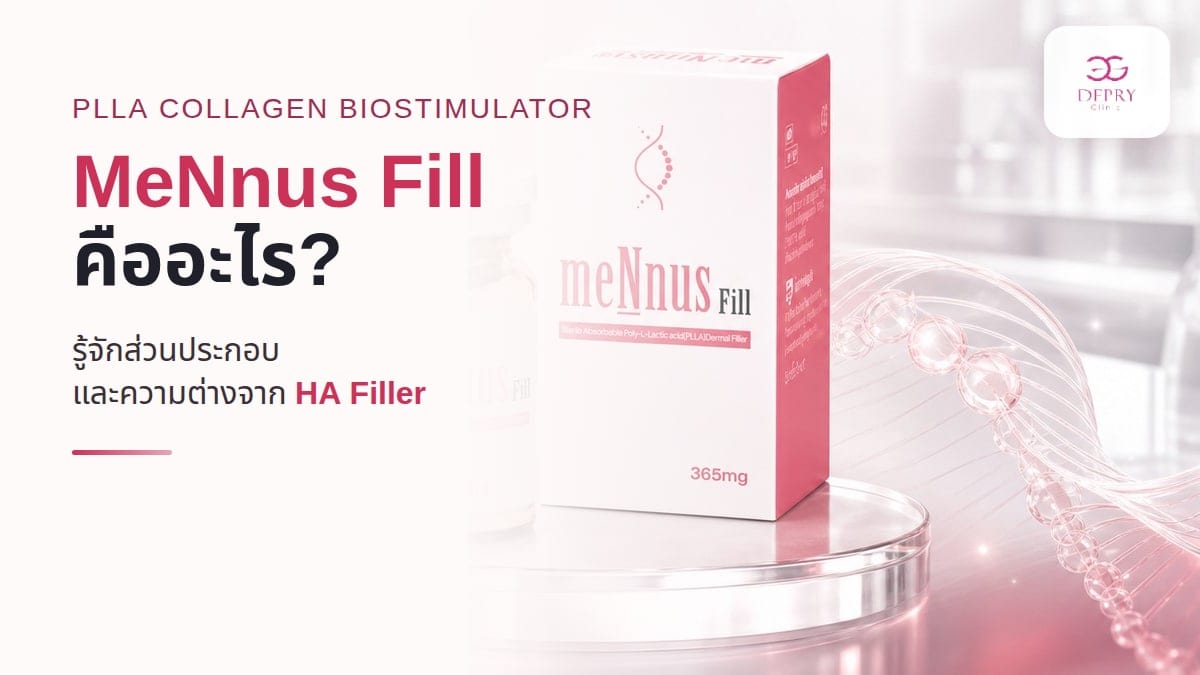
- What is MeNnus Fill?
- What does 365 mg on the box mean?
- How does PLLA work?
- What can it address, and what are its limitations?
- How is MeNnus Fill different from HA filler?
- Who may be a candidate, and who should postpone treatment?
- What kind of results should you expect?
- Side effects and warning signs
- What should you check before deciding?
- Consult about MeNnus Fill in Phitsanulok
- Frequently asked questions
- References
MeNnus Fill is an injectable PLLA collagen biostimulator. It may be considered by people looking to address skin quality and gradual loss of facial volume. It is not an HA filler that directly creates a contour that can be assessed on day one. One important detail is that 365 mg on the box refers to all the powder in the vial, not 365 mg of PLLA. Results require individual assessment, planning, and follow-up.
What is MeNnus Fill?
If you have seen the name MeNnus Fill and wondered whether it is a filler or a collagen stimulator, the short answer is that it belongs to the injectable collagen-stimulator category. Its primary component is poly-L-lactic acid, or PLLA. This group is often called collagen biostimulators because the aim is not simply to fill empty space, but to prompt a tissue response that supports collagen production over time.
The word “Fill” in the name can make it sound as though the product works exactly like hyaluronic acid, or HA, filler. The underlying approach is quite different. HA filler is a gel that a doctor uses to fill a crease or refine a specific contour. PLLA consists of particles that the body gradually breaks down while they stimulate a tissue-repair response, making it more suited to plans where change is intended to develop gradually.
- HA filler: focuses on adding volume and shaping a planned area.
- PLLA biostimulator: focuses on stimulating collagen; changes develop gradually and need to be considered in the context of the whole face.
- They are not interchangeable in every case: one may suit some people, while others may need a combined plan, but assessment should come first.
What does 365 mg on the MeNnus Fill box mean?
Got questions? Dr. Time offers personalized, honest consultations — no upselling.
Consult Dr. TimeThis distinction matters because some promotional materials display the large number in a way that may lead readers to think it is all PLLA. According to the manufacturer's product literature, one vial contains 365 mg of powder in total: 150 mg of PLLA, 90 mg of carboxymethyl cellulose or CMC, and 125 mg of mannitol.
The number in the product name is the total weight of all components in one vial. According to the product literature, the actual PLLA content is 150 mg. Reading the full label allows a more accurate comparison with other products; the largest number on the box should not be used on its own.
| Component listed in the product literature | Amount per vial | General role |
|---|---|---|
| PLLA | 150 mg | The primary particles associated with stimulating collagen production |
| CMC | 90 mg | Helps support and distribute the product after preparation |
| Mannitol | 125 mg | An ingredient that supports the product formulation |
| Total | 365 mg | The total powder weight in the vial, not the weight of PLLA alone |
Each component has a different role, and a higher total weight does not necessarily mean a greater result or a better fit for everyone. Other relevant factors include particle size and properties, product preparation, placement, the doctor's technique, your skin condition, and your individual response.
How does PLLA work?
After a doctor places the product in an appropriate tissue layer, the liquid used to prepare it may initially make the area look fuller. This early fullness is not the final result. As the liquid subsides, the face may appear to return toward its pretreatment state. Meanwhile, the PLLA particles stimulate a tissue response, and collagen production follows gradually.
- Early stage: You may have swelling, redness, bruising, or fullness from the liquid used to prepare the product.
- Next stage: The early fullness may subside, so this is not yet the right time to judge the result.
- Follow-up stage: Collagen-related changes gradually become visible according to each person's response.
- Longer term: Your doctor assesses skin quality, facial balance, and whether further care is needed rather than judging the first-day appearance alone.
A systematic review of 11 randomized trials found evidence supporting improvements in skin thickness, volume, and aesthetic scores with PLLA in some study groups. The researchers also emphasized that the overall quality of evidence was low and that many studies had a high risk of bias. Claims that everyone will obtain the same result, or that duration can be guaranteed, therefore go beyond the available evidence.
What can MeNnus Fill address, and what are its limitations?
Broadly, PLLA may be considered in a plan to restore facial balance that has gradually changed with age—for example, when skin looks thinner, firmness has decreased, or some areas appear flatter or more hollow. But “collagen stimulation” does not mean it can replace every procedure. If the main issue involves strong muscle activity, accumulated fat, substantial skin laxity, or prominent bone structure, another approach or a combined plan may be more appropriate.
- Gradually improving the appearance of skin firmness and quality
- Addressing broader facial volume loss rather than sculpting one small point
- Allowing changes to develop progressively rather than making the face look different in one day
- Sharp contouring or fine correction of asymmetry in the same way as HA in every case
- The final result as soon as the procedure is finished
- The same formula, amount, or placement for everyone
A face that looks hollow may reflect reduced fat, changes in bone, muscle activity, or shadows caused by skin laxity. Choosing a product before identifying the cause can add fullness in the wrong place or make the face look heavier. Assessing the face from several angles matters more than starting with a vial count.
How is MeNnus Fill different from HA filler?
| Topic | MeNnus Fill / PLLA | HA filler |
|---|---|---|
| Core approach | Stimulates collagen and gradually restores volume | Uses a gel to add volume or shape a specific area |
| When changes become visible | Changes develop gradually and require follow-up | The gel's shape can be seen sooner, although early swelling may still be present |
| Correction if the result is unwanted | There is no enzyme that dissolves PLLA on demand | In some cases, hyaluronidase may help dissolve HA after medical assessment |
| Commonly considered for | Broader changes in skin quality and reduced volume | Creases, localized volume deficits, or contours that require precision |
| Key planning consideration | Allow for a gradual response and avoid overtreatment | Select the appropriate gel, amount, tissue plane, and proportions for the area |
There is no way to say which is better without first understanding what your face needs. HA may be more suitable for supporting a crease or creating a precise contour, while PLLA may be considered for broader volume and skin-quality concerns. The important point is not to choose by program name alone or place every concern under the label “lack of firmness.”
Who may be a candidate, and who should postpone treatment?
People who may wish to discuss MeNnus Fill with a doctor
- You feel that your skin and facial tissue have become thinner or lost volume with age.
- You want gradual changes and understand that follow-up is necessary.
- You are comfortable with session-by-session planning rather than a standard formula used for everyone.
- You are ready to provide a complete history of your health, medications, previous procedures, and allergies.
People who should postpone treatment or be assessed with particular care
- You have inflamed acne, a wound, a rash, or an infection in the planned treatment area.
- You are pregnant, breastfeeding, or have a health condition that is not yet under control.
- You have a history of severe allergy, bleed easily, take medication that affects blood clotting, or have an immune-system disorder.
- You have previously received a permanent or unknown filler in or near the area.
- You expect a clearly defined contour change in one session or cannot return for follow-up.
You should mention them even if they were performed years ago, especially permanent fillers, liquid silicone, fillers whose names you do not remember, threads, or surgery. This information can substantially change which areas can be treated, the risks involved, and the follow-up plan.
What kind of results should you expect?
A safer way to think about the result is as a “direction of change,” rather than counting the days until the face transforms. Early fullness may come from liquid and swelling. When this subsides, some people feel as though the effect has disappeared before gradual tissue changes begin to emerge. Follow-up helps distinguish swelling from improved balance and identify areas where adding more would not be appropriate.
The same caution applies to duration. Some PLLA studies have followed results over longer periods, but their products, study populations, and assessment methods differ. Findings from one product should not be used as a direct guarantee for another. Before treatment, your doctor should explain both what can reasonably be expected and what remains uncertain.
Side effects and warning signs to know
Possible effects after injection with a PLLA product include swelling, redness, bruising, pain, tenderness, itching, or a temporary firm area. Research reviews have also reported raised lumps or nodules. Some reactions occur early, while others may appear weeks or months later, so you should have a way to contact the treating clinic and a follow-up plan.
- Unusually severe pain or pain that keeps worsening
- Skin that becomes pale, gray, dusky purple, or develops an unusual mottled pattern around the injection area
- Blurred vision, double vision, any change in vision, or severe eye pain
- Weakness of the face, arm, or leg; slurred speech; severe dizziness; or stroke-like symptoms
- Hot swelling, pus, fever, or signs of a possible infection
The U.S. Food and Drug Administration identifies unintended injection into a blood vessel as an important risk of injectable soft-tissue fillers. It can lead to tissue death, vision problems, blindness, or stroke. Although this event is uncommon, its seriousness makes the choice of doctor, knowledge of anatomy, and an emergency response plan essential considerations.
In some cases, the enzyme hyaluronidase can help correct HA filler, but there is no enzyme that makes PLLA disappear on demand. Careful planning, conservative placement, and waiting to see the tissue response before adding more are therefore especially important.
What should you check before deciding on MeNnus Fill?
- Confirm the exact name and type: Ask which MeNnus Fill version it is, how much PLLA it contains, and the total amount of all components.
- Ask to see the actual box: Check the seal, Thai-language label, lot number, expiration date, importer, and traceable product information.
- Check its status in Thailand: A CE mark or information from Korea is not the same as Thai registration and import status. Ask for evidence relating to the actual product.
- Ask why each area is being considered: Your doctor should explain the cause of the concern and why PLLA is more or less suitable than other options.
- Discuss risk: Ask about expected post-treatment symptoms, warning signs, emergency contact arrangements, and the follow-up date.
- Do not choose by vial count alone: More is not necessarily better. If the placement or timing is unsuitable, the result may look unbalanced and be difficult to correct.
“For my face, which areas may benefit from collagen stimulation, which need contouring, and which do not need treatment yet?” This keeps the conversation focused on your face's actual needs rather than starting with a product name or a popular program.
Consult about MeNnus Fill in Phitsanulok — Depry Clinic
If you are considering MeNnus Fill and live in Phitsanulok, Phichit, Sukhothai, Uttaradit, Kamphaeng Phet, or Phetchabun, the first answer you need is not how many vials to use. It is an assessment of what your face actually needs. A hollow appearance can result from reduced volume, thin skin, accompanying laxity, or a combination of these factors, and some people may be better suited to an option other than PLLA.
At Depry Clinic in Phitsanulok, Dr. Time assesses facial proportions, skin quality, previous injections, and your goals before planning care. If an injectable product is selected, you should be shown the box and verifiable information for the actual product and receive a clear explanation of its benefits, limitations, risks, and follow-up plan.
Frequently asked questions about MeNnus Fill
Q: Is MeNnus Fill a filler or a collagen stimulator?
A: It is an injectable PLLA collagen biostimulator. Its primary purpose is to stimulate gradual collagen production, so it differs from HA filler, which uses a gel to add shape or volume directly.
Q: Does 365 mg on the box mean 365 mg of PLLA?
A: No. The product literature states that 365 mg is the total powder in one vial: 150 mg of PLLA, 90 mg of CMC, and 125 mg of mannitol.
Q: How is MeNnus Fill different from HA filler?
A: HA is a gel that adds volume and refines specific contours. PLLA encourages tissue to build collagen gradually. The choice depends on the cause of the concern, the area, and the desired outcome.
Q: Will my face look fuller on the first day?
A: Early fullness may come from the liquid used to prepare the product and from swelling, both of which can subside. Collagen-related changes require time for the tissue to respond, so the result should not be judged on the first day.
Q: How many sessions are appropriate?
A: There is no fixed number for everyone. Age, skin quality, lost volume, treatment area, previous procedures, and the response after each session all need to be considered.
Q: How long do PLLA results last?
A: Duration varies with the product, treatment plan, area, and individual biology. Research has found longer-term effects in some groups, but the evidence has limitations, so one fixed duration should not be guaranteed.
Q: What side effects should I know about?
A: Swelling, redness, bruising, pain, tenderness, itching, or nodules can occur. Vascular occlusion is uncommon but may be serious. If you develop unusual pain, skin discoloration, or changes in vision, contact a doctor urgently.
Q: What should I check before treatment?
A: Check the box, seal, Thai-language label, lot number, expiration date, importer, and relevant registration documents. Ask your doctor to explain the rationale for the plan and placement, the risks, and the follow-up process.
References
This article keeps product-specific information separate from the broader PLLA evidence so that findings from one product are not used to validate another:
- MeNnus Fill Product Brochure — Manufacturer's composition and product specifications for MeNnus Fill: Read the product brochure
- PubMed: Efficacy and Safety of Poly-L-Lactic Acid in Facial Aesthetics — A 2024 systematic review covering 11 randomized trials: Read the abstract and study details
- PubMed Central: Application of PLLA for Facial Rejuvenation — A review of PLLA's mechanism, uses, and precautions: Read the full article
- U.S. Food and Drug Administration — Risks of injectable soft-tissue fillers and emergency warning signs patients should know: Read the FDA guidance
Written by
ดร.นพ.ณธธรรมภ์ โอภาอภิณัฐฏ์ (หมอธามน์)Clinic physician at de Pry Clinic, Phitsanulok · Thai medical license no. 56524