

- What Is the D-ANCHOR Chin Augmentation Technique?
- What Problems Does the D-ANCHOR Technique Solve?
- Who Is It Suitable For? Who Should Avoid It?
- D-ANCHOR (Subperiosteal Placement) vs. Shallow-Layer Placement: What's the Difference?
- How Much Does It Cost? Which Silicone Is Best?
- How Many Days Until Results Show? How Long Do They Last?
- Does It Hurt? What Are the Possible Side Effects?
- How Should You Care for Yourself Afterward?
- D-ANCHOR Chin Augmentation in Phitsanulok — Depry Clinic
- Frequently Asked Questions
- References
When patients come in to consult me about facial contouring, they're usually worried about two big things. The first is the fear that the chin will sag or shift out of position over time, ending up crooked. The second is the fear of a visible scar under the chin that others might notice when they tilt their head up to talk.
I understand this concern well, because the chin is a very prominent feature on the face. When deciding to place something inside the body for the long term, you naturally want the highest level of confidence. That's why I developed the D-ANCHOR technique at Depry Clinic — to turn conventional chin augmentation into a secure, long-term, worry-free lock of confidence.
What Is the D-ANCHOR Chin Augmentation Technique?
To make this as easy to picture as possible, follow along with me. The D-ANCHOR technique is a deliberate approach to locking silicone into the deepest, safest possible position. The letter "D" stands for the deep layer, or Subperiosteal (the layer beneath the periosteum — the tough tissue that sits directly against the surface of the chin bone). "Anchor" refers to the firm locking mechanism, like a ship's anchor, that holds the silicone in place and prevents it from shifting.
The surgery is performed through an incision inside the mouth, along the gum crease inside the lower lip. I carefully separate the fibers of the chin muscle known as Mentalis vertically, using a precise technique that avoids damaging the muscle. I then create a precisely sized pocket beneath the periosteum and place the silicone snugly against the chin bone, locking it firmly in position. This allows the periosteum to act like a thick blanket that wraps around and permanently locks the silicone onto the chin bone — with no external scar for anyone to see.
The D-ANCHOR technique is chin augmentation performed through an incision inside the mouth, placing silicone in the deep layer beneath the periosteum (Subperiosteal). This uses the body's natural tissue along with a locking mechanism to hold the silicone firmly in place, preventing it from shifting — safe for the long term, with no visible scarring on the face.
What Problems Does the D-ANCHOR Technique Solve?
Got questions? Dr. Time offers personalized, honest consultations — no upselling.
Consult Dr. TimeCan a Short or Receding Chin Really Be Corrected to Look Naturally Longer and More Tapered?
Disproportionate lower-face features — a short chin, a receding chin, or a chin that appears cut off — make the face look short and round. Placing silicone beneath the periosteum helps extend the existing chin bone forward or lengthen it downward in a way that blends naturally. The tissue and outer skin cover the silicone evenly, eliminating problems like a lumpy-looking chin, a visible silicone edge, or an unnatural appearance when the mouth moves while speaking.
How Does This Eliminate Long-Term Worries About the Silicone Shifting or Becoming Crooked?
Long-term silicone displacement or shifting is usually caused by dissecting a pocket that's too wide, or by placing the silicone in the shallow layer above the periosteum (Supraperiosteal). This leaves it vulnerable to the movement of the chin muscle when speaking or chewing, which gradually pushes the silicone out of position. Placing it in the Subperiosteal layer using the D-ANCHOR technique, however, fully withstands the pull of the muscle, so the silicone stays firmly locked in place.
Who Is It Suitable For? Who Should Avoid It?
To help you decide more easily, I've broken down the suitability criteria for the D-ANCHOR technique below.
Suitable For
- Those with a short, cut-off, or receding chin who want to reshape their face with natural dimension
- Those concerned about external scarring who want to avoid a scar under the chin entirely
- Those who want stable, safe, long-term results without needing frequent revision surgery
- Those who previously had shallow-layer chin augmentation, experienced silicone shifting, and want a more secure correction
Should Consult First (Limitations)
- Those with severe jawbone structure problems or bite abnormalities, which may require treatment combining orthodontics with jaw surgery
- Those with an oral infection or severe dental health issues, which must be fully treated before undergoing surgery
D-ANCHOR (Subperiosteal Placement) vs. Shallow-Layer Placement: What's the Difference?
I don't want you to simply take marketing claims at face value. Let's instead look at statistical medical data from international research reports. Placing chin silicone in different layers clearly leads to different long-term outcomes:
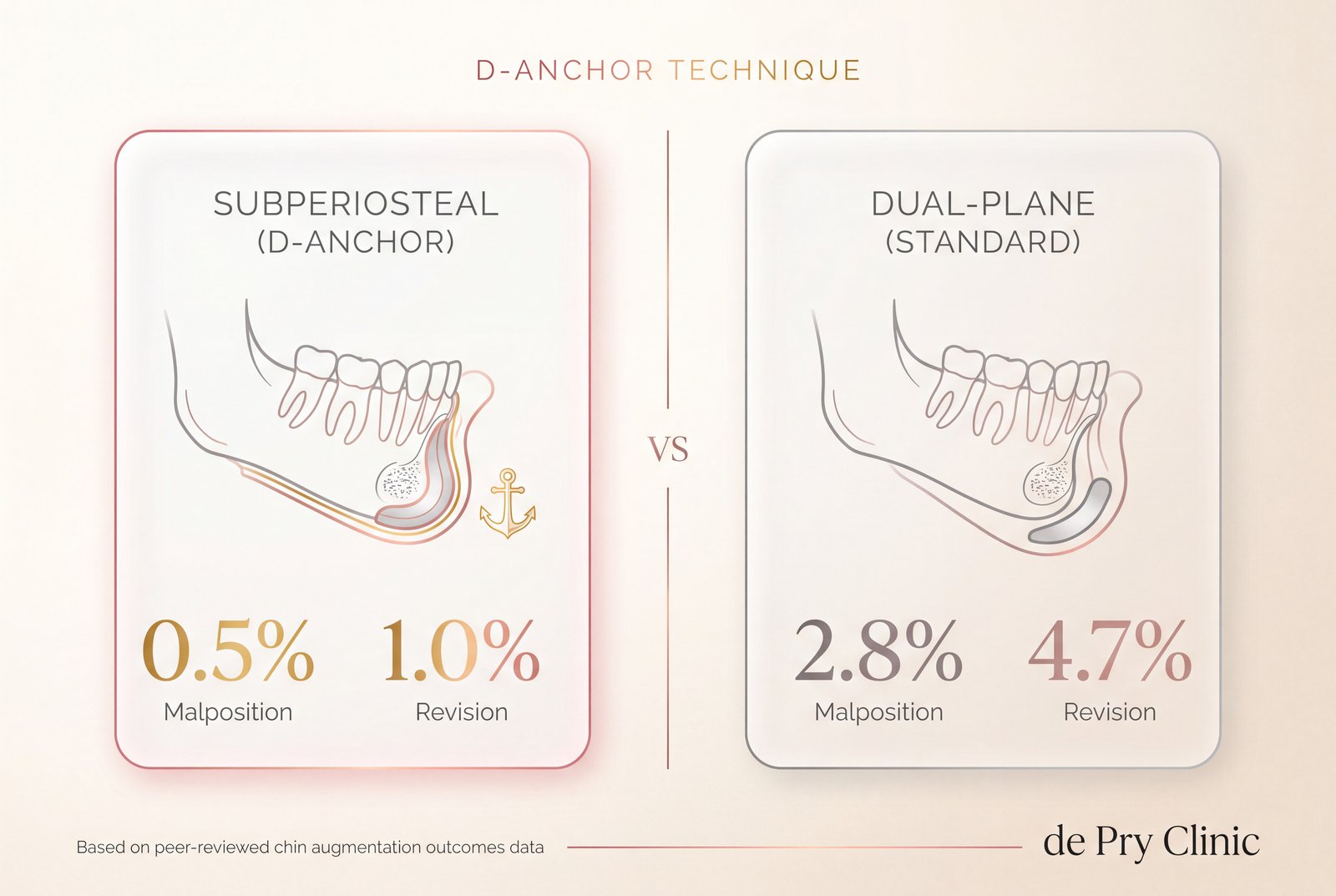
| Comparison Point | D-ANCHOR Technique (Subperiosteal Placement) | Shallow-Layer Chin Augmentation (Dual-plane / Supraperiosteal) |
|---|---|---|
| Chance of Silicone Displacement/Malposition | Very low, only 0.5% | As high as 2.8% |
| Revision Surgery Rate | Only 1.0% | As high as 4.7% |
| Silicone Removal Rate | Only 1.1% | As high as 4.7% |
| Chance of Permanent Numbness (Paresthesia) | Low, only 1.9% | As high as 10.8% |
| External Scarring | None (incision entirely hidden inside the mouth) | Under-chin scar approximately 2-3 cm long (if an external incision technique is used) |
This data clearly shows that placing silicone beneath the periosteum delivers significantly superior safety numbers, meaningfully reducing the risk of the silicone shifting or requiring repeat revision surgery in the future.
How Much Does It Cost? Which Silicone Is Best?
I'm often asked how many types of chin silicone there are, and which one is safest in the long run.
How Do You Choose a Material That's Safe for Chin Tissue in the Long Term?
I use Medical Grade Silicone, which offers high flexibility and is very safe for the body. Large-scale research reports have found that silicone is the chin augmentation material with the lowest rate of numbness or nerve compression compared with other material types:
- Medical grade silicone: average numbness rate as low as 0.4%
- ePTFE (Gore-Tex) material: average numbness rate of approximately 3.2%
- Porous Polyethylene (Medpor) material: average numbness rate as high as 20.1%
As for pricing, D-ANCHOR chin augmentation at Depry Clinic is transparent, with no hidden costs. The price covers the facial structure assessment, silicone carved case-by-case to match your existing bone line, medication, and all aftercare — because I believe safety and avoiding a painful second surgery are what matter most to patients.
How Many Days Until Results Show? How Long Do They Last?
After surgery, many patients want to see their new chin shape right away. I have to be honest that some natural swelling and bruising will occur at first, following this general recovery timeline:
- Days 1-5: Swelling peaks during this period. I recommend applying cold compresses regularly to help reduce it.
- 1-2 weeks: Swelling subsides fairly quickly, the intraoral incision begins to close and heal, and the new chin shape starts to become clearer.
- 1-3 months: The silicone settles and fuses smoothly with the existing chin bone, giving the most natural, tapered facial appearance.
With the D-ANCHOR technique locking the silicone securely beneath the periosteum, these results stay with you permanently for life, without changing shape or shifting from their original position.
Does It Hurt? What Are the Possible Side Effects?
What Does It Feel Like During and After Surgery?
In terms of sensation, I administer thorough local anesthesia before surgery, so you won't feel any pain during the procedure, though you may notice slight tightness or pressure. Once the anesthesia wears off, you'll experience some soreness and tightness, which can be controlled and eased with the pain medication I provide.
Possible Side Effects and How I Manage Safety
No surgery is 100% without risk. I want to explain this plainly so you can feel at ease. Statistics show that general side effects such as infection (1.0%) or bone resorption at the chin (0.68%) can occur if hygiene isn't well maintained or the silicone is placed incorrectly. However, with the D-ANCHOR technique's small incision, precise deep-layer placement, and strict sterile standards, the likelihood of these complications is significantly reduced.
At Depry Clinic, my team and I care for patients like family. We use instruments sterilized to the highest standards and maintain a close follow-up system after your procedure. If you have any questions or concerns, you can reach out to consult me directly at any time.
How Should You Care for Yourself Afterward?
Since the D-ANCHOR technique involves an incision inside the mouth, aftercare focuses mainly on cleanliness, to help the wound heal as quickly and safely as possible.
- Keep strict oral hygiene: Rinse with clean saline solution or a gentle mouthwash after every meal to prevent food debris from getting into the wound.
- Eat soft, easily digestible foods: For the first 7 days, avoid spicy food, hot food, fermented food, and anything that requires heavy chewing, to reduce movement and strain on the chin muscle.
- Avoid sleeping face-down or resting your chin on your hand: Strictly avoid sleeping on your stomach or propping your chin up for the first month, so no pressure is placed on the silicone while the tissue is still bonding.
D-ANCHOR Chin Augmentation in Phitsanulok — de Pry Clinic
I've made it a point to bring this refined knowledge and D-ANCHOR technique to care for patients here, so that patients in Phitsanulok and neighboring provinces such as Phichit, Sukhothai, Uttaradit, Kamphaeng Phet, and Phetchabun can receive excellent, safe, high-quality treatment close to home, without the exhausting journey all the way to Bangkok.
Depry Clinic is a clinic I personally run and manage directly. I assess the facial structure, design and carve the silicone, and perform every case's surgery myself with full attention. Whatever the outcome after your procedure, I remain here to care for and follow up with you continuously — I'm not going anywhere. You can trust that you'll receive the warmest, safest care possible.
Frequently Asked Questions
Will Intraoral Chin Augmentation Cause Bad Breath?
It does not cause permanent bad breath. In the initial period after surgery, there may be temporary bad breath from bacteria accumulating around the wound. However, if patients maintain the hygiene routine I recommend — rinsing frequently and brushing carefully — the bad breath resolves normally once the wound has fully healed and closed.
Will Chin Augmentation Make Speaking or Smiling Look Stiff or Unnatural?
During the first 1-2 weeks, you may feel some tightness or stiffness when smiling due to swelling and movement of the chin muscle (Mentalis). However, since the D-ANCHOR technique separates the muscle fibers vertically rather than cutting through the muscle, once the swelling fully subsides, moving your mouth, smiling, and speaking will return to being 100% natural.
How Many Days of Recovery Does the D-ANCHOR Technique Require Before Returning to Work?
Most patients can return to work or normal daily activities that don't involve strenuous exertion within 3-5 days. Even though there may still be some swelling, it can be covered with a face mask. The internal wound continues to heal gradually, with no need to worry about any external scarring.
Will the Silicone Really Last a Lifetime, or Does It Need to Be Replaced?
High-quality medical grade silicone placed in the deep layer beneath the periosteum can last a lifetime, with no need for replacement — unless the patient wants to change the shape or a complication occurs (which is statistically very rare).
If You Touch or Feel the Chin After Surgery, Can You Feel the Edge of the Silicone?
With the D-ANCHOR technique, since the silicone sits beneath both the periosteum and the chin muscle, the outer tissue covers it densely. This means that when you touch or feel the chin, it feels smooth and blends seamlessly with the existing bone, almost indistinguishable from a natural chin. This is different from shallow-layer placement, where the skin can be thin enough for the silicone edge to be clearly felt.
References
I want you to be able to verify the sources I used to write this article yourself — click through to read the originals:
- PubMed — A review study comparing complication rates across different chin augmentation techniques, the source of the 0.5% vs 2.8% figures cited in this article: pubmed.ncbi.nlm.nih.gov/36880789
- PubMed — A large-scale review of complications across all types of facial implant materials, covering 4,273 cases: pubmed.ncbi.nlm.nih.gov/40225117
- PubMed — An analysis of adverse events from FDA reports concerning facial implant materials: pubmed.ncbi.nlm.nih.gov/29346485
- PubMed — Long-term follow-up data on patients who received silicone facial structure implants: pubmed.ncbi.nlm.nih.gov/7182281
- PubMed Central (PMC) — A review discussing the necessity of fixation for facial silicone implants: pmc.ncbi.nlm.nih.gov/articles/PMC9984266
- PubMed Central (PMC) — A case study on revision surgery for complications from displaced chin silicone implants: pmc.ncbi.nlm.nih.gov/articles/PMC12942616
- Explore Plastic Surgery — A detailed look at intraoral chin implant placement surgical techniques: exploreplasticsurgery.com
- Plastic Surgery Key — Foundational textbook information on alloplastic augmentation of the chin and mandible: plasticsurgerykey.com
Written by
ดร.นพ.ณธธรรมภ์ โอภาอภิณัฐฏ์ (หมอธามน์)Clinic physician at de Pry Clinic, Phitsanulok · Thai medical license no. 56524