- What is Halyx
- How it works beneath the skin
- Halyx vs HA filler and other collagen biostimulators
- Who it suits, who should consult first
- When you see results, how many sessions, how long it lasts
- Is it safe — side effects you should know
- What I want to tell you honestly
- How much it costs, is it worth it
- Getting Halyx in Phitsanulok — Depry Clinic
- Frequently asked questions
- References
Lately more and more patients have been messaging me about Halyx. The first question I usually hear is, "Dr. Time, is Halyx a filler or a collagen biostimulator, and is it really as good as people say?" I understand that hesitation well, because new names in the beauty world appear so quickly that patients sometimes get confused about what something actually is and how it differs from what they have heard before. Let me explain it the way I would if we were sitting and talking face to face — both what is known, and what I will honestly say still needs to be checked clearly first, so you can decide with complete peace of mind.
What is Halyx
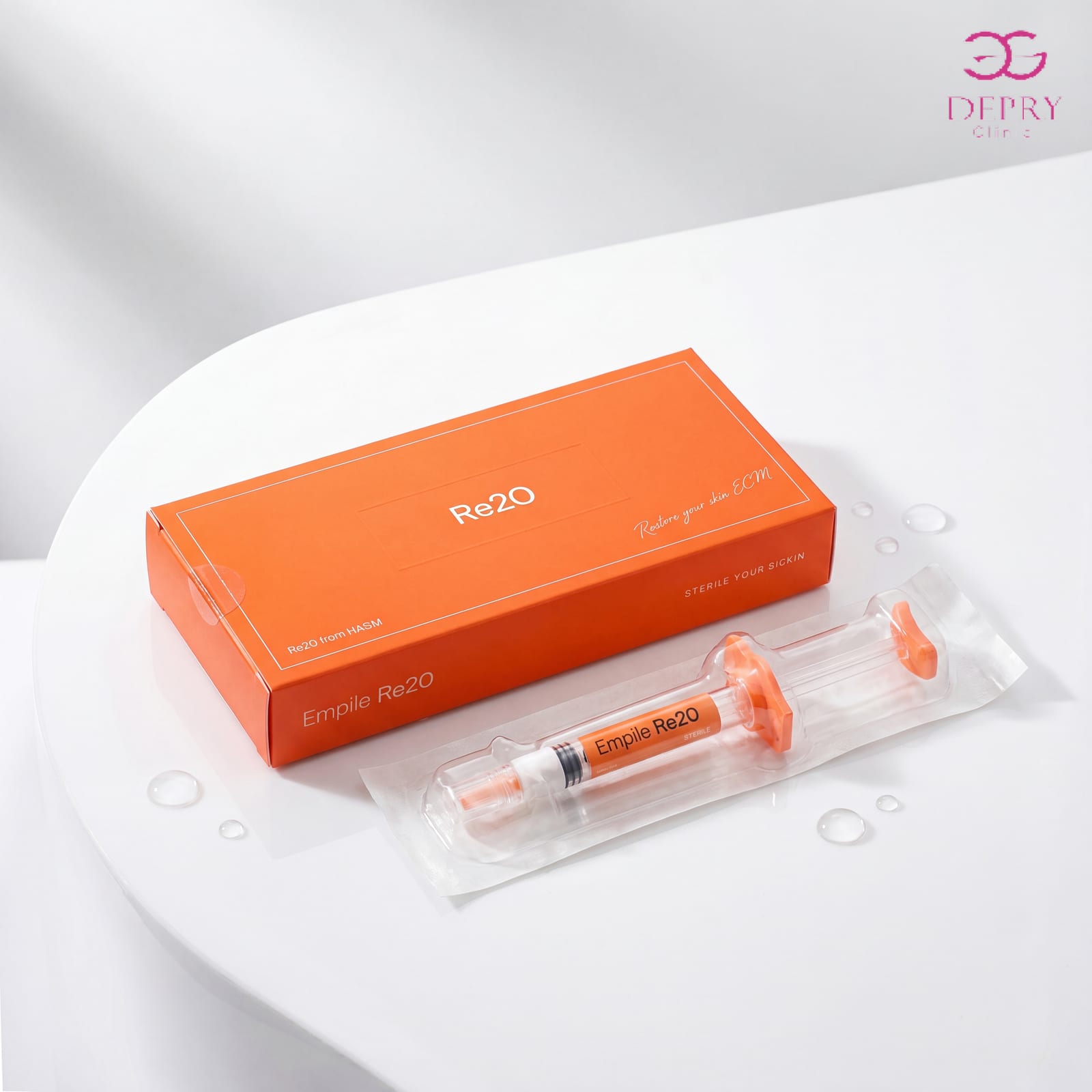
To put it briefly before we get into detail: Halyx is talked about within the family of injectables known as "collagen biostimulators." In simple terms, it does not go in and "plump up" instantly like a volumizing filler — instead it is meant to gradually awaken your skin so it starts making its own collagen again.
Here I want to be honest from the very start. The public information about the "exact formulation" of Halyx is not yet clear enough to state with certainty. Some sources mention the polycaprolactone (PCL) family — a biodegradable synthetic used to stimulate collagen — while others tie the name Halyx to hyaluronic acid. So I would rather not guess on your behalf, and I will keep to calling it a "collagen-stimulating injectable" for now. As for the real formulation of the lot you will be injected with, only the label and the อย. (Thai FDA) registration can give you certainty — and I will come back to this point again in the section where I speak frankly.
How it works beneath the skin
Got questions? Dr. Time offers personalized, honest consultations — no upselling.
Consult Dr. TimeThe next most common question I get is, "So what does it do under the skin that I have to wait a month or more to see results?" Let me paint a picture you can understand without being a doctor.
As we age, the collagen under our skin gradually decreases, so the face looks flatter, folds deepen, and skin becomes lax and tired-looking. What a collagen biostimulator like Halyx is meant to do is act like a "signal" that wakes our collagen-producing cells back up. Then it is our own collagen that gradually makes the skin look firmer, little by little, while the injected material itself is gradually broken down by the body over time.
What is neocollagenesis, and why do I keep stressing this word?
This process of the body making new collagen is what we doctors call neocollagenesis. It is the very heart of this family, because the product triggers a gradual response that gets your collagen-producing cells working and laying down new collagen while the product itself slowly breaks down. The result is a slow filling and firming, not an instant plumping on the day of injection. This is why I stress this word so often: once you understand that "the real thing is your own collagen," you immediately understand why it takes time.
Why aftercare instructions matter
For many collagen-stimulating injectables, the clinic will have aftercare advice, such as massaging the injected area or specific care depending on the type of product. I want you to understand this is not a ritual — it helps the product spread evenly and lowers the chance of it clumping into a lump. Listening to and following the aftercare advice is part of a good result, not a small thing to overlook.
Halyx, as a collagen biostimulator, does not "fill" your face instantly — it is meant to "awaken" your face to make its own collagen again. What is on your face in the long run is your own collagen — that is why it takes time, and it is the same reason the result looks natural.
Halyx vs HA filler and other collagen biostimulators
At this point patients usually ask right away, "Wait, so how is it different from the filler I have heard about, and why do some places also mention Sculptra or other products?" So I want to compare them clearly, the way I often explain to patients. Each family is designed for a different goal. None is simply "the best" — there is only the one "best for you." And because the formulation of Halyx still needs label confirmation, I place it in the corner of the collagen-biostimulator family.
| Comparison | HA filler (hyaluronic acid) | Sculptra (PLLA — collagen biostimulator) | PCL family / Halyx (collagen biostimulator) |
|---|---|---|---|
| How it works | Adds volume directly at the injection point | Stimulates the skin to make its own collagen little by little | Focuses on stimulating collagen; some formulas may give a slight initial fill from the carrier |
| Onset of results | Immediate, on the day of treatment | Gradual, usually clear after 2-3 months | Gradual; collagen result becomes prominent later, similar to other biostimulators |
| Naturalness | Natural if injected in the right amount, but looks "filled" if overdone | Looks like your own skin tissue, improving gradually without standing out | Fairly natural, depending on technique and formula |
| Duration of results | Generally several months to around 1-2 years depending on type | Long; manufacturer data cites up to around 2 years | Often lasts for years, but check the data for the actual formula used |
| Reversible? | Yes, there is a dedicated dissolving agent | No direct dissolving agent, so good technique from the start is essential | Generally no direct dissolving agent either, so technique matters greatly |
| Who it suits | Those who want immediate results and clear shaping in specific spots | Those who want a subtle change and a long-term investment, with no one noticing | Those who want to gradually look fresher with their own collagen, choosing a product they can verify |
See how this table does not say which one wins? It only tells you what you are looking for. If you have an important event next week and want to see results right away, an HA filler may suit you better. But if you can accept the wait, and you want the people around you to gradually feel "hey, you look so fresh lately" without knowing what you had done, then a collagen biostimulator is the approach that fits you better. As for whether it is Halyx, Sculptra or another in this family, I ask you to choose based on "a product whose origin you can verify" and "someone who injects with understanding."
Who it suits, who should consult first
I understand that by the time you have read this far, many of you are thinking, "So is it right for me?" I would like you to look at it this way.
Good fit for
- Collagen biostimulators suit people whose face is starting to flatten with age, whose nasolabial folds are deepening, whose cheeks are beginning to hollow, and whose skin looks tired despite enough sleep — and, importantly, people who are "patient enough to wait for results," because this is not for the impatient.
Talk to the doctor first
- As for the people I would like to talk through things in detail with before deciding: those who are pregnant or breastfeeding, those with autoimmune conditions, those with an active infection or inflammation in the area to be injected, and those with a history of hypertrophic scars or who scar into keloids easily. This group does not always mean treatment is impossible, but I will assess each person individually, because your safety always comes before the goal of looking beautiful.
If you are not sure which group you fall into, that is precisely the reason to come and talk with me first — not a reason to back away. You asking lots of questions does not bother me at all. On the contrary, it helps me care for you more precisely.
When you see results, how many sessions, how long it lasts
This is what I most want you to understand before treatment, because most people who are disappointed with collagen biostimulators are not disappointed because the product is bad — they are disappointed because they expected results at the wrong time.
When you see results
I will tell you honestly that this family is definitely slower to show than HA filler, because it has to wait for your body to make new collagen. Results generally start to become clearly noticeable from around 2-3 months onward; some people notice it a little sooner. In the early days, if your face looks unusually full, in some formulas that may be the water or carrier mixed with the product, which will subside within a few days — so do not be alarmed.
How many sessions, how long it lasts
For most collagen biostimulators I plan a course — several sessions spaced weeks apart. The number of sessions depends on how little collagen you are starting from and how much change you want. Results often last for a year or more, but the exact figure must rely on the data for the actual formula used. So I see this as a long-term investment rather than a one-and-done treatment, and I will assess your face in person before planning the number of sessions for you.
- First few days If your face looks unusually full, in some formulas that may be the water or carrier mixed with the product, which will subside within a few days.
- Around 2-3 months onward Results generally start to become clearly noticeable, because it has to wait for your body to make new collagen; some people notice it a little sooner.
- Across the course (several sessions spaced weeks apart) The number of sessions depends on how little collagen you are starting from and how much change you want.
- A year or more Results often last for a year or more, but the exact figure must rely on the data for the actual formula used.
Please do not judge the result in the first week or first month. New collagen takes time to form. If you get impatient and add something else too soon, you may end up with a combined result beyond what you intended. That is why I schedule periodic follow-ups, so we can see the true result together before deciding anything further.
Is it safe — side effects you should know
I know the question that has really been on your mind from the start may be this one — "Is it safe, doctor?" I will answer honestly: overall, collagen-stimulating injectables are a family that is widely used and has a reasonable body of safety data. But "safe" in my meaning is safe when in the hands of someone who understands the technique, uses a product whose origin can be verified, and follows up with you — not safe in the abstract.
The common, usually temporary side effects are that the injected area may be red, swollen, bruised or tender in the early period, all of which gradually improve on their own. Some people may notice small lumps or bumps under the skin. More serious events, such as vascular problems from the injection, are very rare, but they are an important matter I am always vigilant about, and they are why choosing your provider directly affects your safety.
What causes lumps or bumps under the skin, and can they be prevented?
The good news is that lumps or bumps like these are mostly related to technique, not random events beyond control. They tend to happen when injection is in the wrong layer, the product is mixed in the wrong proportion, or aftercare is incomplete. That means choosing a provider who pays attention to depth, concentration and aftercare can greatly reduce the chance, and if it does happen, there are usually ways to improve it — it is not something you have to live with forever.
If you choose to be treated by someone who cares about technique from the preparation stage, injects in the correct layer, gives clear aftercare advice, and is ready to have you come back whenever something feels off, the risks can be managed. I want you to be afraid of the right thing — afraid of being treated by someone who does not follow up or uses a product of unknown origin, rather than afraid of the product itself.
What I want to tell you honestly
Now that we are here, I would like to sit and talk with you a little, with no brochure in between. There are three things I always say to every patient before doing Halyx.
First, and this one is specific to Halyx — the formulations of different brands are not equal. As I said from the start, the public information on the formulation of Halyx is not yet clear enough to state with certainty. Some sources tie it to PCL, others to HA. So I would rather you not trust only the name used in an ad. What I want you to do is ask to see the box and label of the exact lot being injected, look at the ingredient name, the concentration, and the manufacturer. You have every right to ask to see all of it.
Second — check the อย. (Thai FDA) registration every time. Today's beauty market has a great deal of counterfeit and grey-market products that have not passed inspection. They are genuinely cheaper, but you are gambling your own face on a product of unknown origin. Checking the อย. registration is the first gate that helps screen out products that should not come near your face, and it is something you can verify yourself.
Third, and the one I stress the most — "a good brand" matters less than "an injector who understands." Most collagen biostimulators have no direct dissolving agent like HA filler does. That means the result depends especially on the hands and understanding of the person doing it — from assessing whether it truly suits you, to preparing the product, the depth of injection, all the way to caring for you afterward. When you are with someone who attends to every step in detail and is ready to take responsibility for caring for you afterward, you are reducing your own risk before the first needle even goes in.
- The formulations of different brands are not equal — ask to see the box and label of the exact lot being injected.
- Check the อย. (Thai FDA) registration every time, the first gate you can verify yourself.
- "A good brand" matters less than "an injector who understands," because most have no direct dissolving agent.
How much it costs, is it worth it
I know this is the question many people want to ask from the start but feel shy about. There is no need to feel shy — money matters, and you should ask about it clearly. I will answer you frankly: I will not give a fixed number in this article, because if I throw out a random figure, it usually leads you to the wrong decision.
What the price depends on
The cost of Halyx can vary a great deal from case to case, because it depends on several factors I need to see your face in person to judge — for example, the amount needed, which depends on how little collagen you start from and how much change you want, the area being treated, and the total number of sessions in the course. So I would like you to look at "the whole course and how long the result lasts" rather than comparing the price per syringe with other places as a single number. Cheap work that you have to go back and fix is usually more expensive in the long run, and cheap products of unknown origin may come at a risk that is not worth it at all.
The most direct way that also saves you time is to message me on LINE and tell me what you are worried about, and I will help give you a rough estimate of about how much you would likely need, and whether it is worth what you are looking for — with no pressure to go ahead.
Halyx is worth it for someone whose goal is to "gradually look fresher in a way that is their own tissue and lasts," and who chooses a product they can verify. It is not worth it if you want to see results immediately next week, or if you choose it only because it is the cheapest without checking the label. Worth is not measured by being the cheapest, but by whether it truly answers what you need, safely — that is what I want to help you find the answer to before you pay.
Getting Halyx in Phitsanulok — Depry Clinic
If you are in Phitsanulok or a nearby province and looking for a trustworthy place to get Halyx, I would like to invite you to sit and talk with Dr. Time at Depry Clinic first — and I want to stress the words "talk first," because that is what I value most.
Here I will not start by selling you a course; I start by assessing your face and listening to what you are really worried about. Sometimes, after we talk, I actually advise that Halyx may not be the best answer for you right now and that there is a more fitting option. I can say this because I see you as a patient to care for, not a customer to close a sale on. And before treatment I will show you the label and check the อย. (Thai FDA) registration of the product so you feel at ease. Once you decide to go ahead, I will care for you throughout the course, scheduling periodic follow-ups so we can watch your new collagen gradually do its work together. This is why I want you to feel assured that you will not be abandoned after you pay.
Frequently asked questions
Is Halyx a filler?
It depends on how you define a filler. Halyx is talked about within the biostimulator (collagen-stimulating) family, meaning it is not focused on adding volume directly like a typical HA filler, but instead gradually prompts your skin to make its own collagen. I would rather you look at the actual label and the อย. (Thai FDA) registration than trust the name used in an ad.
What is Halyx made of, PCL or HA?
I will be honest with you: the public information I have seen is not clear enough to state with certainty. Some sources place it in the polycaprolactone (PCL) family, while others tie it to hyaluronic acid. So I would rather not guess on your behalf. The safest approach is to ask to see the box and label of the exact lot being injected, and to check the อย. registration first, every time.
Does Halyx work fast, or how long do I have to wait?
With a collagen-stimulating mechanism, results usually become clearer gradually rather than appearing the day you are injected. In general this family starts to show noticeable results from around 2-3 months onward, because your body needs time to make new collagen. That is why I always tell patients not to judge the result in the first week.
Is Halyx safe, and what side effects are there?
Collagen-stimulating injectables are, overall, considered safe when done by someone who understands the technique. The most common, usually temporary, side effects are swelling, redness, bruising and tenderness. Some people may get small bumps or lumps under the skin. Serious events such as vascular problems are rare, but they are exactly why you should choose someone who follows up with you.
How is Halyx different from an HA filler?
An HA filler adds volume with immediate results and has a dedicated dissolving agent. Halyx, as a collagen biostimulator, gradually has your skin build its own collagen. It is slower to show, but it looks like your own skin tissue, which suits people who want a subtle change that does not have others asking what they have had done.
How many sessions does Halyx need, and how long do results last?
Most collagen-stimulating products are done as a course, usually several sessions spaced weeks apart. Results can last for a year or more depending on the type and protocol. I would like to assess your face in person before planning the number of sessions for you, because everyone starts from a different point.
How much does Halyx cost?
The price depends on how much is used, the area being treated, and the number of sessions in the course. I would rather not throw out a random number, because that usually leads to the wrong decision. I suggest you message Dr. Time on LINE and tell him your case, and he will give you a rough estimate based on the real situation.
Where can I get Halyx in Phitsanulok?
At Depry Clinic in Phitsanulok. Dr. Time will always assess your face and listen to your goals first, to see whether Halyx suits you or whether there is a better option. He will show you the label and check the อย. registration so you feel at ease before treatment, then care for you throughout the course.
References & how to verify
I want you to be able to verify everything yourself, not just take my word for it. These are the sources I rely on and would like you to read further on your own.
- PubMed Central — academic article on the safety and side effects of collagen-stimulating injectables: pmc.ncbi.nlm.nih.gov
- U.S. FDA — official information on Dermal Fillers (Soft Tissue Fillers): fda.gov
- NHS — guidance on having cosmetic procedures safely: nhs.uk
- อย. (Thai FDA) — always check the product registration before treatment: oryor.com
Written by
ดร.นพ.ณธธรรมภ์ โอภาอภิณัฐฏ์ (หมอธามน์)Clinic physician at de Pry Clinic, Phitsanulok · Thai medical license no. 56524