
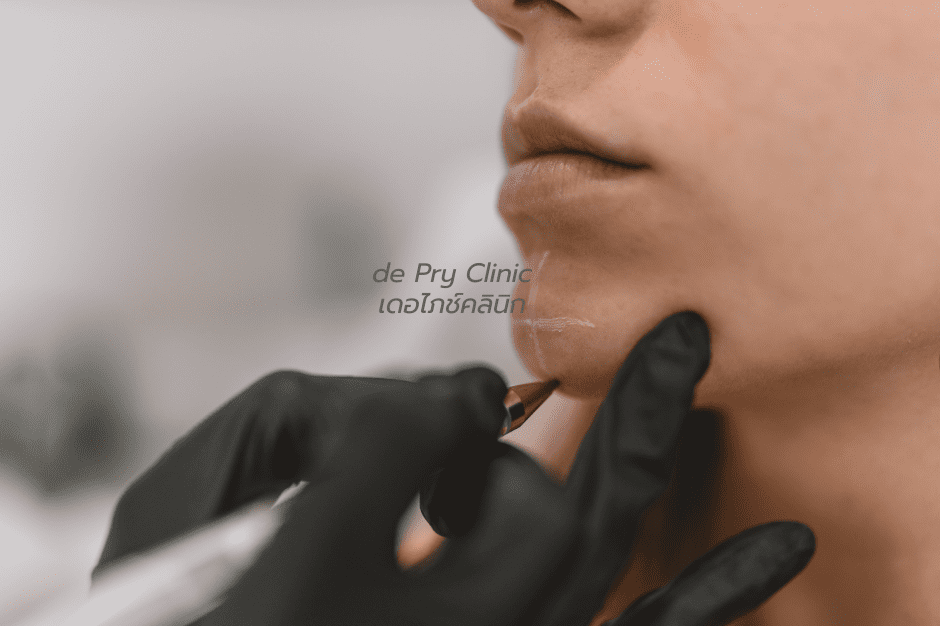
- What is jawline filler? Why the jawline matters so much for facial beauty
- Undefined jawline, square sunken face, double chin starting to show — what can filler do
- Jawline filler vs masseter Botox — what's the difference and which to choose?
- Why jawline filler needs a "firm" product (high G-prime)
- Men can do it too — a sharp, masculine jawline
- Realistic results: how fast you'll see them, how long they last
- Who's a good fit, who should avoid it
- Getting jawline filler in Phitsanulok — de Pry Clinic
- Frequently asked questions
- References and verification
"Jawline filler" means injecting a filler material at the jaw angle and chin to build a sharp, continuous jawline in a V shape. It helps people with an undefined jawline, a short chin, or an emerging double chin achieve a more sculpted, balanced face. It's a completely different thing from "masseter Botox" — filler adds structure, while Botox reduces muscle. They can be done together. This area requires a filler firm enough to support the structure, and men can do it too for a sharp, masculine jawline. In this article, Dr. Time explains it all — from what filler can genuinely do, to who it may not be the answer for.
What is jawline filler? Why the jawline matters so much for facial beauty
Many people look in the mirror and feel that "my face doesn't look defined" or "my face looks round and blurry, with no lines," even though their skin looks fine and their weight isn't an issue. I get questions like this very often, and the answer usually comes down to one thing — the "jawline."
The jawline is the line that runs from below the ear along the jaw, through the jaw angle, and ends at the tip of the chin. This is the line that "frames" the face. When this line is sharp and continuous, the face looks sculpted, slim, and youthful. When this line is blurry, the jaw angle disappears, or the chin is short and receding, the face looks "sunken" with no structure.
Jawline filler means injecting a filler material (mostly Hyaluronic Acid, or HA, a substance the body already has naturally) into the key points of the jawline — especially the jaw angle and chin — to "add structure" where it's missing. This brings the jawline back to being sharp and continuous as a single line, so the face looks more like a balanced V or oval shape, while still being your own face, not someone else's.
Picture a good "picture frame." The image inside looks far more valuable when the frame is sharp and well-proportioned. The face is the same — sometimes we don't need to fix the "picture" (skin/eyes/nose), but just the "frame," and that alone changes the whole face. Jawline filler does exactly this job.
If you're not yet familiar with what HA filler is or how safe it is, I recommend reading up on the basics of HA filler in the article What is HA filler as well. In this article, I'll focus specifically on the "jawline/jaw angle/chin."
Undefined jawline, square sunken face, double chin starting to show — what can filler do
Got questions? Dr. Time offers personalized, honest consultations — no upselling.
Consult Dr. TimeLet me clearly separate out which symptoms jawline filler "genuinely helps," because many people come in with problems that sound similar but have different causes, and the fixes differ too.
1. Undefined jawline / missing jaw angle
Some people have a naturally small jaw structure, or with age the bone and fat around the jaw angle sink, making the jawline blurry and the face look round with no angles — this case responds very well to filler, because adding volume at the jaw angle "pulls" the jawline back into clear view.
2. Square, sunken face / short, receding chin
The "square, sunken face" many people describe usually means a face that looks square in the upper part but "sunken" in the lower part because the chin is short or receding. When the chin doesn't project forward to meet it, the jawline looks broken and short. Adding filler to the chin to make it longer and well-proportioned helps the jawline run continuously, making the face look slimmer in a natural way.
3. A double chin starting to show (but not yet severe)
A double chin, or a lost dividing line between the face and neck, isn't always caused by fat — if it comes from a short chin or undefined jawline, adding filler to give the chin and jaw angle a sharper structure makes the dividing line between the face and neck clearer, so the double chin looks reduced. However, I have to be honest: if the double chin comes from heavy fat accumulation under the chin, or very saggy skin, filler alone won't be enough. This is important, and I'll go into detail in the "who should avoid it" section below.
Jawline filler is great at "adding missing structure," but it's not great at "reducing excess." If your main problem is heavy fat under the chin, or saggy skin from older age, simply adding filler may make the face look bigger instead of slimmer. Correctly assessing "what the problem really is" therefore matters more than rushing to inject.
Jawline filler vs masseter Botox — what's the difference and which to choose?
This is one of the questions I get most often, and it's a point of great confusion, because both involve the "jaw" — but in reality they work through completely different mechanisms.
In short, filler = adding in, while Botox = reducing. Jawline filler adds volume to build structure and a sharper jawline, while masseter Botox (botulinum toxin) is injected to make the enlarged jaw muscle (masseter), enlarged from chewing/teeth grinding, relax and shrink — so the face narrows in people whose square face comes from muscle.
| Topic | Jawline filler | Masseter Botox (Botulinum toxin) |
|---|---|---|
| Mechanism | Adds structure (increases volume) | Reduces the jaw muscle (makes the muscle shrink) |
| Best for | Undefined jawline, missing jaw angle, short chin | Square face from an enlarged jaw muscle (frequent chewing/teeth grinding) |
| Result | Sharper jawline, well-shaped chin, V-shaped face | Face narrows at the sides, jaw becomes slimmer |
| Onset | Shape changes quickly, settles within 2–4 weeks | Gradually visible over 2–6 weeks (the muscle shrinks slowly) |
| Duration | Around 12–18 months (HA filler) | Around 4–6 months |
| Can they be combined | Yes, and they often complement each other — reduce the enlarged muscle + add the missing structure = the most balanced jawline | |
You can see it's not always a case of "choose one or the other." In many cases where the face is square because of an enlarged jaw muscle and the chin is short too, I'll plan to do both together — Botox to reduce the muscle flaring out to the sides, then filler at the chin so the jawline runs continuously downward. The result is a face that's slimmer and more dimensional than doing just one of them. If you'd like to understand combining filler with Botox in more depth, read more at Doing filler together with botulinum toxin.
Why jawline filler needs a "firm" product (high G-prime)
This is a "behind-the-scenes" matter that most patients don't know about, but I want you to know it, because it's the reason why "the cheapest filler" isn't the answer for the jawline.
HA filler doesn't come in just one type — there are many formulas with different "firmness and strength." The value I use to measure this is G-prime (G′) — simply put, "the ability to support the structure and hold its shape under pressure."
- High-G-prime filler (firm/strong) — suited to work that needs to "support structure" so the line stays sharp and holds its shape, such as the jaw angle, chin, and jawline, because this area constantly bears force from chewing, talking, and sleeping on one's side, and needs a product that holds its shape.
- Low-G-prime filler (soft/smooth) — suited to areas that need natural softness, such as under the eyes, the lips, and shallow nasolabial folds. If you bring a soft product like this to the jawline, the structure won't build up, and the shape will be flat and collapse quickly.
This is why choosing the "right type of filler for the location" is a matter for the doctor, not for promotions. Using the wrong type of filler on the jawline not only gives an unattractive shape that breaks down quickly, but also wastes money on repeat work. Randomized clinical trials in humans also confirm that high-G-prime fillers deliver structure-building results, such as chin augmentation, safely and effectively when used in the right location with the right technique.
Before getting jawline filler, you can ask directly: "Which filler are you using, is it firm enough for the jawline, and is it FDA-approved?" A clinic that genuinely cares for you will be able to answer and will be happy to show you the product box. At de Pry Clinic, Dr. Time always lets you see and check it right in front of you.
Men can do it too — a sharp, masculine jawline
I want to say this clearly: jawline filler is not just a women's thing. Lately, more and more male patients have come in to consult about this — working professionals who want to look more distinguished in photos, those who feel their chin is a bit short, or those who want a more pronounced jawline.
But men's goals differ from women's. Most women want a slim, pointed V-shaped face, while men want a jawline that's "sharp and angular in a masculine way" (masculine jawline) — wide enough, defined enough, looking strong, not a slim, pointed female face. So the technique, the injection points, and the amount of filler differ.
I'll design the jawline to look proportionate to your existing facial structure and your gender. The goal is to "look better in a way where people say your face looks great, but can't quite tell what you did," not "looking like you've had work done" — naturalness is the heart of jawline work for both women and men.
Realistic results: how fast you'll see them, how long they last
Let me walk through every step truthfully, because knowing the truth in advance puts you at ease and prevents surprises.
- The day of treatment — the facial shape changes quickly (because filler adds volume directly; you'll see results in 3 seconds after filling, in terms of shape), but during this period it may look a little firmer or more swollen than the true shape.
- The first 3–7 days — there may be slight swelling or bruising in some spots, which is normal and gradually subsides.
- 2–4 weeks — the filler settles in, and the shape is at its most stable and beautiful. This is the time to assess the real result and add a touch-up if needed.
- 12–18 months — the period during which HA filler in the jawline area usually lasts, before gradually breaking down naturally (varying from person to person depending on the type of filler and metabolism).
There are studies on adding HA at the jaw angle with long-term follow-up, finding that it helps reshape the jawline without significantly interfering with oral function and chewing, which is consistent with what I see in real patients — when done in the right location and amount, the jawline looks more beautiful while you go about everything in daily life as normal.
HA filler has one advantage I really like — it's adjustable. If the result isn't to your liking or there's a problem, the doctor can inject an enzyme (hyaluronidase) to dissolve the HA filler out, unlike surgery, which is much harder to revise. This is one reason filler is an option you "can start with without being too afraid" — as long as there's a doctor caring for you and FDA-approved products are used.
Who's a good fit, who should avoid it
A good fit for
- People with an undefined jawline and blurry jaw angle who want a sharper jawline
- People with a short/receding chin that makes the lower face look sunken
- People with an emerging double chin "from a short chin or undefined jawline" (not from heavy fat)
- Men who want a more defined, distinguished jawline
- People who want to start with an adjustable method, without surgery
Should avoid it, or need special assessment
- Double chin from heavy fat under the chin — filler alone isn't enough and may make the face look bigger; a fat-reduction method should also be considered.
- Very saggy skin — if sagging skin is the main problem, skin tightening may be a better answer, or they may need to be done together.
- Currently pregnant or breastfeeding
- Having an infection or wound at the injection site
- Having a history of HA filler allergy, or an autoimmune disease/certain underlying conditions that require caution
This is the heart of "having a doctor assess first," because symptoms that look similar (such as "a face that doesn't look defined") can come from different causes, and the fixes differ vastly. Dr. Time will always look at your actual facial structure first. If filler is the best answer, I'll do it fully; but if I see that your case should use another method, I'll tell you straight and recommend the more suitable path, because I want you to get real results, not just to get injected.
Getting jawline filler in Phitsanulok — de Pry Clinic
If you're in Phitsanulok and looking for a place to get jawline filler with a doctor genuinely caring for you at every step, de Pry Clinic is glad to take care of you. Here, Dr. Time assesses the facial structure and injects every case personally, designing the shape to be proportionate to your existing face, not stamping out a one-size-fits-all shape for everyone.
Patients who come to get jawline work with me aren't only from the city of Phitsanulok — many drive in from Phichit, Sukhothai, Uttaradit, Kamphaeng Phet, and Phetchabun, because they want the doctor who assesses the facial structure and inserts the needle himself to care for them from start to finish. I understand well that facial shape is a delicate matter, and you have to trust someone who can truly deliver.
Want to know whether your jawline is suitable for filler, or whether it should be done together with something else? Message Dr. Time directly. You can consult first, with no course-pushing, and if you'd like to see all of the clinic's services, drop by the Our Services page, or if you'd like to read about filler from a closer-to-home perspective, try reading Filler in Phitsanulok as well.
Frequently asked questions
What's the difference between jawline filler and masseter Botox, and which should I choose?
They're entirely different mechanisms. Jawline filler is "adding structure" at the jaw angle and chin to build a sharp, continuous V-shaped jawline, while masseter Botox (botulinum toxin) is "reducing the muscle" of an enlarged jaw to narrow the face. If your face is square because of an enlarged jaw muscle → Botox helps. If your jawline is undefined/your chin is short/the jawline has disappeared → filler helps. Some people have both, and I can do them together because they complement, not contradict, each other.
Can jawline filler fix a double chin?
It helps with some types. If the double chin comes from a short chin or undefined jawline, adding filler to give the chin and jaw angle a sharper structure makes the dividing line between the face and neck clearer, so the double chin looks reduced. But if the double chin comes from heavy fat accumulation under the chin, or very saggy skin, filler alone may not be enough and other methods are needed to help, such as fat reduction or skin tightening. I'll assess first what your case is suited to, so you don't spend money for nothing.
What type of filler does the jawline need, and why must it be firm?
The jawline is an area that must "support structure" so the line stays sharp and holds its shape, so it requires a filler with high firmness and strength (a high G-prime value), unlike under-eye or lip filler, which needs to be soft. If you use a product that's too soft on the jawline, the structure won't build up, and the shape will be flat and break down quickly. Choosing the right type of filler for the location is therefore very important, and it's something that must be chosen by the doctor, not chosen by the cheapest promotion.
Can men get jawline filler?
Yes, and it's a procedure increasingly popular among men. But the goal differs from women's. Most men want a jawline that's "sharp and angular in a masculine way" (masculine jawline), not a slim, pointed V-shaped face. I'll place the points and choose the amount so the jawline looks strong, proportionate to your existing facial structure, and natural — not looking like you've had work done.
When does jawline filler show results, and how long does it last?
The facial shape changes quickly, because filler adds volume directly, but during the first 1–2 weeks there may be slight swelling or look a bit firmer than usual. The true shape will be at its most stable and beautiful about 2–4 weeks after the procedure. As for the durability of HA filler in the jawline area, it generally lasts around 12–18 months, depending on the type of filler, the amount, and each person's breakdown rate. I'll schedule a follow-up to review the result and add a touch-up based on the actual need, not push you to repeat it.
Does jawline filler hurt? Is there swelling or bruising?
It hurts little, because anesthetic is applied beforehand and most fillers have anesthetic mixed in. The jawline area may feel a bit tight during the filling. Afterward there may be slight swelling or bruising for 2–3 days, especially if a needle is used in a spot with blood vessels. I'll use techniques and choose tools (needle or cannula) suited to each spot to reduce the chance of bruising, and give clear aftercare instructions.
Who is not suitable, or should avoid jawline filler?
For people with very saggy skin or heavy fat under the chin, filler alone may not be the answer, and other methods are needed too. In addition, people who are currently pregnant/breastfeeding, have an infection at the injection site, have a history of HA filler allergy, or have certain autoimmune diseases should always consult a doctor first. I'll take a history and assess first every time. If it's not suitable, I'll tell you straight and recommend a better path.
How is jawline filler different at de Pry Clinic, Phitsanulok?
Dr. Time assesses and injects every case personally, starting by looking at your actual facial structure to see where the jawline has disappeared, and which chin or jaw angle should be filled. He chooses a filler firm enough to support the structure, uses only FDA-approved, verifiable fillers, and designs the shape to be proportionate to your existing face, not stamping out a one-size-fits-all shape for everyone — because a beautiful face is one that's natural and is you.
References and verification
I want you to be able to verify the information I use yourself — here are the medical references this article cites:
- U.S. FDA — official information on fillers (dermal/soft-tissue fillers): what they are, which areas they can be used on, and safety precautions: Dermal Fillers (Soft Tissue Fillers) — FDA
- NHS (United Kingdom) — consumer guidance on fillers, the risks you should know, and the importance of choosing an appropriately qualified practitioner: Dermal fillers — NHS
- Aesthetic Surgery Journal (PMC) — a randomized clinical trial confirming that high-G-prime (high-G′) fillers can be used for chin augmentation safely and effectively — supporting the point that a firm filler is needed to support the structure: Safety and Effectiveness of Two High-G′ Soft Tissue Fillers for Chin Augmentation
- Dentistry Journal (PMC) — a follow-up study on adding HA at the jaw angle (mandibular angle harmonization), finding that it reshapes the jawline without interfering with oral function — supporting the point about realistic results and being able to live normally: Orofacial Function After Mandibular Angle Harmonization with Hyaluronic Acid
- DermNet — a dermatological overview of fillers, the types of fillers, and possible side effects: Dermal fillers — DermNet