
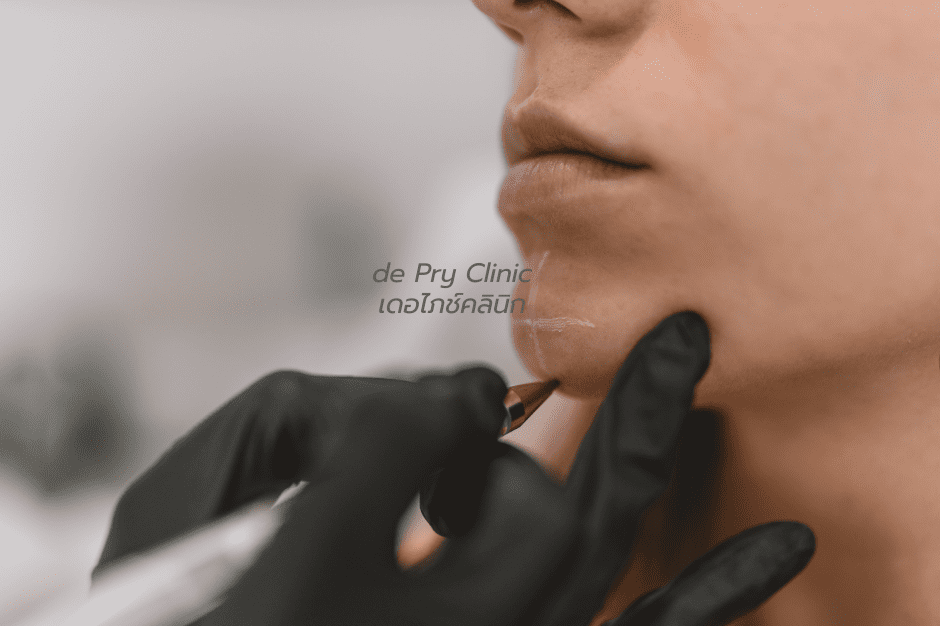
- You want fillers but don't know where to go — the doctor understands this worry
- Why "choosing where to get injected" matters more than you think
- A 6-point checklist for choosing a safe filler doctor/clinic
- Danger signs you should walk away from
- A real doctor + genuine product vs. an unqualified injector + fake product
- Check the product's authenticity and the clinic's registration yourself (doable in 5 minutes)
- At de Pry Clinic, we care for you as a "doctor" does — from before the first needle
- Get it done in Phitsanulok — de Pry Clinic
- Frequently Asked Questions
- References and verification
Filler that is injected correctly is safe and can look beautifully natural. What's dangerous isn't the filler itself, but "who does the injecting" and "what is being injected." Before you decide, please check 3 main things — (1) the injector is a doctor with a genuine medical license, (2) the clinic is registered as a medical facility with the HSS, (3) the filler is genuine and verifiable with the FDA — you can ask to see the box, label, and lot number in front of you. In this article, Dr. Time has compiled a complete checklist, along with the danger signs you should walk away from, so you can make your decision with peace of mind.
You want fillers but don't know where to go — the doctor understands this worry
The doctor hears this question very often: "I want fillers for my nasolabial folds, under-eyes, chin, or lips, but I don't know where to go — I'm afraid of ending up somewhere bad." Many people open up the internet and only get more confused, because there are hundreds of clinics, with promotions both cheap and expensive, and some places inject at homes or in hotels. Then there are the news stories of disfigured faces, blindness, and filler blocking blood vessels that surface from time to time — until you feel like "I want to be beautiful, but I'm afraid of getting hurt for nothing."
The doctor understands this feeling well. The biggest fear of someone who wants fillers usually isn't about price, but about "being afraid of an unqualified injector, being afraid of fake products." The fear that whoever holds the needle to your face could be just anyone, and that whatever is being injected into your face could be just anything. This fear is completely valid and reasonable, because your face is something that stays with you for your whole life.
The good news is that this worry can be solved by "knowing how to choose." If you know what to look for before you decide, almost all of the risk disappears on its own. So the doctor would like to invite you to go through this checklist together, to make your filler experience something to be glad about rather than something to fear.
Why "choosing where to get injected" matters more than you think
Got questions? Dr. Time offers personalized, honest consultations — no upselling.
Consult Dr. TimeMany people think fillers are simple — just "inject and you're done." But the truth is that beneath the skin of our face there are important blood vessels hidden everywhere, especially around the nasolabial folds, the bridge of the nose, between the eyebrows, and under the eyes. If filler is injected in the wrong spot and ends up blocking a blood vessel, the blood that used to nourish the skin or the eye is cut off. The consequences can be severe, ranging from skin necrosis to permanent blindness.
The doctor isn't telling you this to scare you, but to show how important "the person holding the needle" is. A truly trained doctor knows the anatomy of the face, knows where the blood vessels are, injects with techniques that reduce risk, and — most importantly — knows what to do immediately if something unexpected happens. A non-doctor has no way of knowing any of these things, and when something goes wrong, they can do nothing to help.
What the doctor described may sound frightening, but in reality, severe complications are very uncommon when injected by a doctor in a standard medical facility. Filler is still a procedure that can be safe and look beautifully natural — you just need to choose the right place, the right person, and the right product, and you'll be able to take care of yourself with confidence. Fear is meant to help us "stay aware," not to make us "too afraid to take care of ourselves."
A 6-point checklist for choosing a safe filler doctor/clinic
This is the checklist the doctor wants you to keep with you before deciding to get fillers anywhere. When all 6 points are met, it means you're in safe hands.
1. The injector must be a "doctor" with a genuine medical license
Injecting fillers into the face is the practice of medicine under the law, and must be done only by a doctor who holds a medical license — not an "assistant," not a salesperson, and not a beautician. You have the right to ask for the injecting doctor's name and to see their medical license. A straightforward clinic will always be happy to tell you who is taking care of you.
2. The clinic must be registered as a medical facility with the HSS
A legally compliant venue must be registered as a medical facility with the Department of Health Service Support (HSS), Ministry of Public Health, and must display the medical facility operating license with its license number in a clearly visible place, along with the sign of the doctor in charge. If you walk in and don't see any license, or the injection venue is a home, a beauty salon, or a hotel, that is not a medical facility.
3. The filler must be genuine, FDA-approved, with a verifiable QR/lot number
Genuine filler comes with a box and a Thai-language label specifying the FDA registration number, lot number, and expiration date, and usually has a QR code you can scan to verify. You have the right to ask the doctor to open the box and inject in front of you every time. A standard clinic will be proud to show you, because it is confident in what it uses. See how to verify it yourself in the article How to check genuine vs. fake fillers
4. The doctor assesses and takes your history before injecting (no rushed sales)
Before injecting, the doctor who truly cares for you will take your history — such as underlying conditions, current medications, allergy history, what you've been injected with before, and whether you're pregnant — and then assess your facial structure and listen to your concerns before making recommendations. Sometimes the doctor may say you don't need fillers yet, or that something else would suit you better. A doctor who "listens first and isn't in a rush to sell a package" is a very good sign.
5. Has hyaluronidase and an emergency response plan
A clinic that cares with medical standards always keeps filler-dissolving medication (hyaluronidase) on hand, in case filler enters a blood vessel and must be dissolved as quickly as possible, along with a plan and equipment for handling emergencies. This is what an "unqualified injector" or injecting outside a medical facility does not have, and it is the key dividing line between "injected and safe" and "injected and at risk."
6. The doctor provides follow-up care, never abandoning you
Filler injection doesn't end with the last needle. Afterward you may have questions, swelling or bruising you want to consult about, or sometimes you need a follow-up appointment to review the results. A good clinic has a doctor providing ongoing care, reachable — not finishing the injection and then being impossible to find. See whether the place gives you a way to come back when you have a concern.
- Cared for by a licensed doctor; can tell you the doctor's name
- Displays the HSS medical facility license clearly
- Injects in a clean procedure room, within a medical facility
- Opens the filler box, shows you the label/lot/FDA in front of you
- Takes history and assesses first, no rushed selling
- Has hyaluronidase + an emergency response plan
- Has a doctor for follow-up care, reachable
- Suspiciously abnormally cheap prices
- Pressures you to decide quickly/transfer today
- Won't let you see the box, label, or the product being injected
- Injects at homes, hotels, beauty salons
- Won't say who does the injecting/not a doctor
- No history-taking, no assessment, just injects
- Unreachable after the procedure
Danger signs you should walk away from
Besides checking that all 6 points are met, the doctor wants you to remember these "warning signs" too. If you encounter any one of them, the doctor recommends you stop and walk away first — no need to feel awkward, because your face is always more important than being polite.
- Abnormally cheap prices — genuine filler has its costs. A price far below the market is usually traded for fake products, products without FDA approval, split-shared product, or an injector who isn't a doctor.
- Rushing you to decide — "Today-only promotion," "last slot left," "transfer your deposit right now." Pressuring you to hurry is a sales technique, not medical care. Injecting into your face should give you time to think and ask until you're at ease.
- Won't let you see the box/label — if you ask to see the product to be injected and they dodge, claiming it's already split, already prepared in the syringe, or there's no box to show, be suspicious that it may not be genuine.
- Injecting somewhere that isn't a medical facility — at homes, condos, hotels, nail salons, beauty salons, or event booths — none of these is a medical facility where filler can be injected legally and safely.
An "unqualified injector" is someone who isn't a doctor but carries a bag around to inject filler/Botox at homes or hotels. The price is often tempting and cheap, but there's no assessment, no knowledge of vascular anatomy, often products without FDA approval — and when complications occur — such as filler blocking a blood vessel with the risk of blindness — they have neither the knowledge, the antidote, nor the facility to help in time. The resulting damage is usually hard and far more expensive to fix than the price difference you saved.
A real doctor + genuine product vs. an unqualified injector + fake product
To make it clearer, the doctor would like to compare "being injected by a doctor in a medical facility with genuine product" against "being injected by an unqualified injector with product of unknown origin," to show where the differences lie.
| Topic | Real doctor + genuine product + in a medical facility | Unqualified injector + fake product + outside a medical facility |
|---|---|---|
| Injector | Doctor with a medical license | Non-doctor, no license |
| Venue | HSS-registered medical facility, clean procedure room | Home, hotel, beauty salon |
| The filler | Genuine, FDA-approved, lot/QR verifiable | No FDA approval, split-shared, unknown origin |
| Before injecting | Takes history, assesses, listens first | Injects right away, no assessment |
| Emergencies | Has hyaluronidase + a response plan | No antidote, can do nothing to help |
| After the procedure | Doctor provides follow-up care, reachable | Cannot be found |
| Overall risk | Low, manageable | High, and hard to fix when something goes wrong |
"The cheapest" is not the same as "the most worth it." Safe filler depends on 3 pillars — a real doctor · genuine, FDA-verifiable product · in an HSS-registered medical facility. When all three are in place, almost all of the risk disappears on its own. Before deciding, just ask everything and ask to see it. A good clinic will always be happy to let you verify.
Check the product's authenticity and the clinic's registration yourself (doable in 5 minutes)
The good news is that you can check it easily yourself — you don't need to be a doctor. The doctor recommends these 2 steps.
Check whether the filler is genuinely FDA-registered
Go to the website oryor.com of the Food and Drug Administration, choose the product verification menu, then type in the brand name of the filler the clinic uses. If a listing appears, it means it's properly registered; if nothing appears, be cautious. And don't forget to ask to see the actual box and compare it with the label, lot, and expiration date in front of you. Read the detailed method for telling genuine from fake in the article How to check genuine vs. fake fillers
Check whether the clinic is registered as a medical facility
Every medical facility must be registered with the Department of Health Service Support (HSS). You can check the list of medical facilities and the doctors in charge through the HSS channels (hss.moph.go.th) or by calling the HSS hotline 1426. And when you arrive at the clinic, look for the medical facility operating license displayed in a clearly visible place. If you want to understand filler safety more deeply, read on at Is filler safe? What you need to know before injecting
At de Pry Clinic, we care for you as a "doctor" does — from before the first needle
By this point, the doctor wants you to feel more at ease, because filler "can be done safely and look beautifully natural" when it's in the right hands. Everything the doctor has described in this checklist isn't theory — it's the way Dr. Time intends to care for everyone who trusts us enough to walk in.
Dr. Time would like to share how we work here — not to boast, but so you can feel confident:
- The doctor always listens first, never rushes to inject — even though the doctor can roughly assess from first glance where your facial structure should be addressed, the doctor chooses to take your history and listen to your concerns first, because as a doctor, you must understand the person in front of you before recommending anything. Sometimes the doctor will tell you straight that you don't need fillers yet, or that there's a more suitable option for you.
- Sees you as a person to care for, not a sales figure — the doctor intends to care for everyone the way he cares for his own family. Anything that's unnecessary or not worth it for you, the doctor won't recommend, and every recommendation is backed by medical reasoning.
- Dr. Time injects every case himself — there's no assistant or just anyone doing it for him, because injecting into the face is a doctor's duty.
- Uses only genuine, FDA-approved filler — opens the box and lets you see the label and lot in front of you every time. You can check oryor.com together too.
- Prepared to respond — keeps hyaluronidase and an emergency care plan ready, because safety must always come before beauty.
- The doctor owns the clinic himself, provides ongoing care, doesn't disappear — if you have any concern after the procedure, you can come back to the doctor. The doctor intends to care for his patients over the long term, not to finish and be done with you.
The doctor doesn't want anyone's beauty to be traded for risk, and will never let anyone who trusts him end up facing substandard products or careless care.
Get it done in Phitsanulok — de Pry Clinic
If you're in Phitsanulok or a nearby province and want fillers done safely under the care of a real doctor, de Pry Clinic would be glad to care for you. Over time, patients have traveled to see the doctor from Phichit · Sukhothai · Uttaradit · Kamphaeng Phet · Phetchabun, because they want trustworthy care without traveling all the way to Bangkok. Here, Dr. Time assesses and injects every case himself, uses only FDA-approved filler, and is ready to answer every question so you can decide with peace of mind — no package pushing.
Want to start taking care of yourself in a way where you don't have to be afraid, because a real doctor cares for you at every step? See all our services on the Our Services page, or message Dr. Time directly. You can consult first — no pushing.
Frequently Asked Questions
How do I choose a safe filler clinic?
Look at 3 main things before deciding. One, the injector must be a doctor with a genuine medical license. Two, the clinic must be registered as a medical facility with the Department of Health Service Support (HSS), with the license number displayed visibly. And three, the filler must be genuine and FDA-approved — you can ask to see the box, label, lot, and verify the QR in front of you. One more point: a good clinic will always assess and take your history first, won't rush to sell, and will have an emergency response plan with hyaluronidase ready to fix things if a problem arises.
How can I tell if a filler is genuine?
Genuine filler comes with a box and a Thai-language label specifying the FDA registration number, with a lot number, expiration date, and usually a QR code or sticker to scan for verification. You can ask the doctor to open the box and inject in front of you, and also go to oryor.com of the Food and Drug Administration to search the brand name and check whether it's genuinely registered. A standard clinic will always be happy to let you verify. If a place won't let you see the box or label, be cautious.
Where can I check whether a clinic is registered?
A legitimate medical facility must be registered with the Department of Health Service Support (HSS), Ministry of Public Health, and must display the medical facility operating license with its license number in a clearly visible place. You can check the list of medical facilities and doctors in charge through the HSS channels (hss.moph.go.th) or by asking the HSS hotline 1426. If the venue where you'll be injected isn't a registered medical facility — for example, injecting at a home, a beauty salon, or a hotel — that is a danger sign you should walk away from immediately.
Is an abnormally cheap filler price scary?
Yes, it is. Genuine, properly imported filler has its costs. If you encounter a price far below the market, it's usually traded for one thing or another — for example, fake product, product without FDA approval, split-shared product of unknown origin, or an injector who isn't a doctor. The cheapest price doesn't mean the most worth it, because if a complication arises, the treatment cost and the risk to your face are far more expensive than the difference you saved. The doctor wants you to focus on safety and genuine products first.
If a problem arises after a filler injection, why is hyaluronidase important?
Hyaluronidase is an enzyme that can dissolve HA-type filler. It's like an "antidote" that must always be kept on hand at the clinic, because if filler enters a blood vessel unintentionally — the most dangerous complication — the doctor must inject to dissolve it as quickly as possible during the golden hour. A clinic with a real doctor providing care will prepare this medication and have an emergency response plan ready. Places where injections are done by non-doctors or outside a medical facility usually don't have these things, and don't even know what to do when something goes wrong.
What is an "unqualified injector," and how is it dangerous?
"Unqualified injector" is a term for someone who isn't a doctor but carries a bag around to inject filler or Botox at homes, hotels, or beauty salons, without a medical license and not within a medical facility. It's dangerous because there's no prior assessment, no knowledge of the facial vascular anatomy, often products without FDA approval, and when a complication occurs they have neither the knowledge, the medication, nor the facility to help in time. Injecting substances into the face is the practice of medicine that must be done only by a doctor in a medical facility.
Before a filler injection, what should the doctor do for me?
The doctor who truly cares for you will take your history first — such as underlying conditions, current medications, allergy history, what you've been injected with before, and whether you're pregnant — then assess your facial structure and talk about your concerns and what you truly want before recommending where to inject, how many cc's, or sometimes saying you don't need fillers yet. A doctor who "listens first" and isn't in a rush to sell is a sign that you're in the hands of someone who sees you as a patient, not a sales figure.
Where should I choose for filler injections in Phitsanulok?
Choose a clinic registered as a medical facility with the HSS, with a licensed doctor providing the care personally, using genuine, FDA-verifiable filler, and willing to let you see the box of medication in front of you. At de Pry Clinic, Phitsanulok, Dr. Time assesses and injects every case himself, always takes your history and talks with you first, uses only FDA-approved filler, and has hyaluronidase and an after-care plan ready. You can consult first with no pushing.
References and verification
The doctor wants you to be able to verify the information he uses yourself — here are the references this article draws from:
- Food and Drug Administration (FDA, Thailand) — the system for verifying health products and the registry of medical devices/drugs, used to search a filler brand name and check whether it's genuinely registered: oryor.com
- Department of Health Service Support (HSS), Ministry of Public Health — the agency regulating medical facilities and clinic registration; you can verify medical facilities and file complaints via the hotline 1426: hss.moph.go.th
- U.S. Food and Drug Administration (FDA) — information on the safety and risks of dermal fillers (soft tissue fillers), including complications from intravascular injection: fda.gov — Dermal Fillers (Soft Tissue Fillers)