

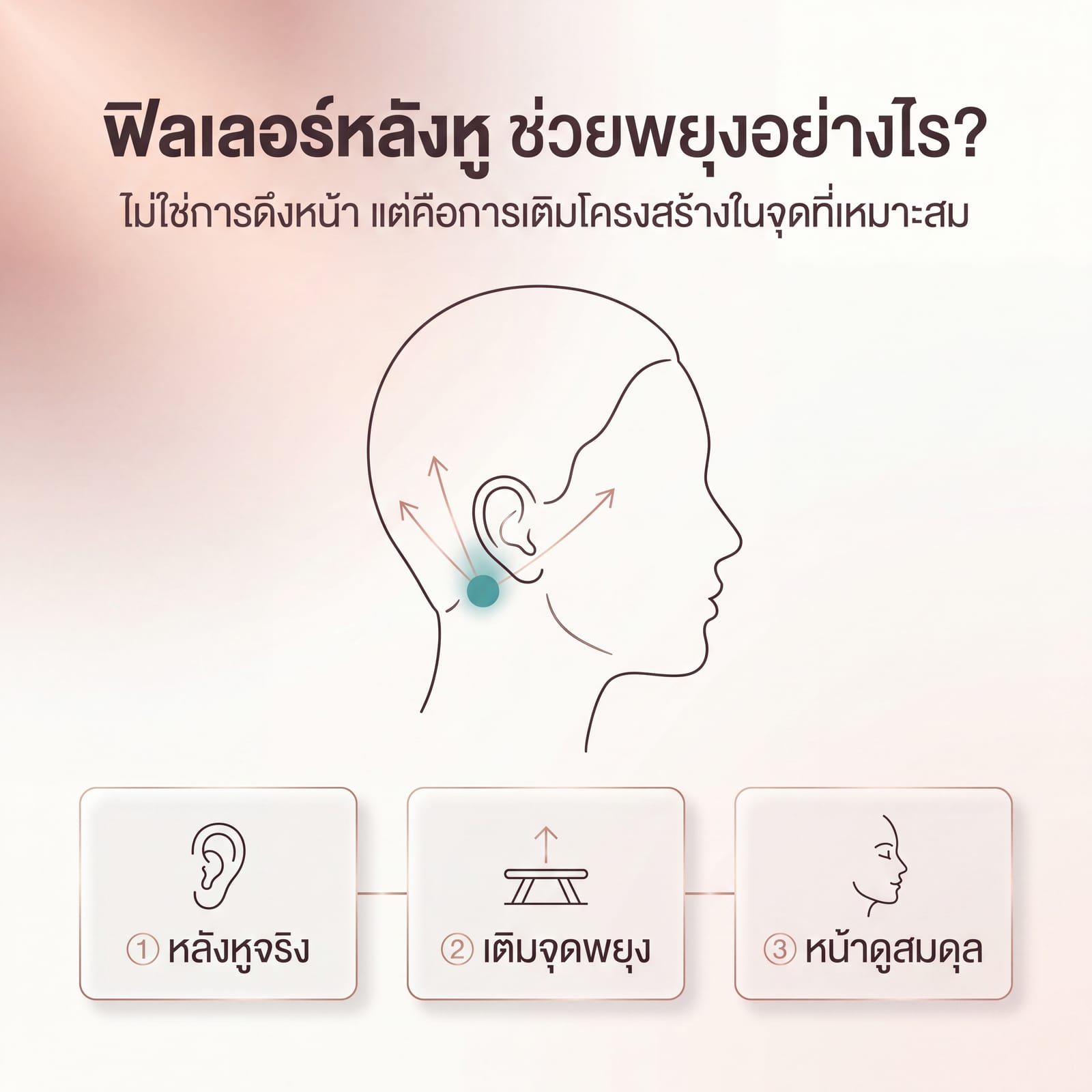
“Filler behind the ear” is not a fixed procedure and does not pull facial skin. It is a patient-friendly description of assessing support in a lateral or posterior zone near the ear. In selected facial structures, restoring volume there may help the cheeks or jawline look more balanced.
What Does “Filler Behind the Ear” Mean?
When patients mention “filler behind the ear,” I understand it as a question about a posterior or lateral support zone near the ear. It is not a standardized procedure or a one-size-fits-all point. Facial changes rarely come from one area alone, so the relationship between the temples, cheeks, and jawline needs to be assessed as a whole first.
Why Is This Area Considered, and How Can It Support Facial Structure?
Got questions? Dr. Time offers personalized, honest consultations — no upselling.
Consult Dr. TimeThink of the skin and fat layers of the face like a piece of fabric draped over a supporting frame. When the support on the sides of the fabric decreases, the overall look can appear saggy and flat. Adding volume to the appropriate position does not "pull" the skin, but rather helps the lateral structures better support the tissues once again.
Anatomical reviews and ultrasound imaging studies explain that restoring structure to the temple area can influence the alignment of lateral facial tissues. Consequently, this can help the cheeks or jawline appear more supported in some individuals. However, the results depend on the tissue layers, bone structure, the amount of volume loss, and the level of skin laxity unique to each person.
| What Filler in This Zone May Help With | What Not to Expect |
|---|---|
| Restoring balance to the lateral facial structures | Pulling severely sagging skin like surgical lifting |
| Making parts of the cheeks or jawline appear more supported | Using the exact same injection point for every facial shape |
| Helping the face look less tired from volume loss in some individuals | Guaranteed results or identical changes for everyone |
Who is it Suitable For? Who Should Consult a Doctor First?
This zone may be one of the areas I consider when patients have hollow temples, flat lateral faces, or want the overall appearance of their cheeks and jawline to look more balanced. However, if there is significant skin laxity or if the primary issue lies in a different tissue layer, this method may not be the sole answer. A clear, comprehensive facial evaluation is more useful than starting with one presumed treatment point.
How Much Does It Cost?
I would not want to guess at a price for this area. First, I need to see whether this is truly the source of the concern in your facial structure and whether another area should be considered alongside it. After an assessment, I can explain the appropriate plan and its actual cost much more clearly.
What Should Your Expectations for Results Be?
A good goal is to achieve a balanced look while remaining true to your natural self, rather than over-tightening or unnaturally changing your facial shape. Fillers help restore volume and support in specific areas, but they are not a replacement for addressing all types of skin laxity.
What You Need to Know Before Deciding
Dermal filler is a medical procedure, and there are critical blood vessels and tissue layers in the temples and lateral areas of the face. You should always have a doctor assess your face and explain the risks before proceeding. If you experience unusually severe pain, skin color changes, or any visual symptoms after the procedure, you must contact your doctor immediately.
Before deciding, you can ask to see the packaging and verify the product information with the clinic. You can also ask why that specific point was selected for your unique facial structure. Getting clear, easy-to-understand answers is just as important as the procedure itself.
How to Care for Yourself After the Procedure?
Primarily follow the personalized instructions provided by your doctor and attend all follow-up appointments. If you have any concerning symptoms, do not wait for them to resolve on their own without notifying the clinic.
Assessment of Lateral Facial Support Near the Ear in Phitsanulok — Depry Clinic
At Depry Clinic, Dr. Time begins by assessing the overall face to determine whether the issue stems from volume loss, skin laxity, or specific facial proportions first. It is not always necessary to inject every point. Many of our patients travel from Phichit, Sukhothai, Uttaradit, Kamphaeng Phet, and Phetchabun because they want a clear, detailed explanation that helps them make decisions with peace of mind.
Frequently Asked Questions
Does everyone need behind-the-ear injections?
No, it is not necessary for everyone. It is simply one support zone that may be considered based on individual facial anatomy, not a universal formula.
Can it replace a surgical facelift?
No. Fillers are not surgery, and their results should not be directly compared or guaranteed.
References
I have selected several reference sources used for these explanations, in case you would like to explore them further on your own:
- PubMed Central — Support concepts of temple fillers: temporal lifting review
- PubMed Central — Temple anatomy and ultrasound: ultrasound-guided filler anatomy
- PubMed Central — Facial fat compartments and retaining ligaments: facial fat compartments and lifting
- U.S. FDA — Risks and precautions of dermal fillers: Dermal Fillers (Soft Tissue Fillers)
- อย. — Starting point for verifying product information in Thailand: oryor.com