- Why does the face sag? And why do these three names pop up every time you search
- Understand the heart of it first: HIFU and RF are different energies with different jobs
- What is Ulthera (Ultherapy) — the original HIFU that "sees" the skin layers
- What is Thermage — the radiofrequency that tightens and smooths the whole surface
- What is Ultraformer III — the finely adjustable, easy-to-access HIFU
- A clear comparison table: Ulthera vs Thermage vs Ultraformer
- So which one should I choose? Choose by your "facial problem," not by the name
- Does it hurt? How many days of recovery — every step told honestly
- How many days until results, how long they last (and why it's not permanent)
- What's the price range, how is it calculated, and why each place differs
- Safety — why "who performs it" matters more than the device's name
- Consult about skin lifting in Phitsanulok — de Pry Clinic
- Frequently Asked Questions
- References and verification
All three devices lift and tighten the skin using "heat" that stimulates the skin to produce new collagen — but they use different energy and work at different layers. Ulthera and Ultraformer III belong to the HIFU group (focused ultrasound), firing deep down to the SMAS layer, so they excel at "lifting" a sagging facial frame. Thermage, meanwhile, uses radiofrequency (RF) to spread heat across the whole surface, so it excels at making the skin "tighter, smoother, and more refined." There's no real answer to "which one is best" — there's only "which one suits your face best." In this article, Dr. Time will explain it in a way that lets you choose correctly even if you know nothing about it.
Why does the face sag? And why do these three names pop up every time you search
I get this question very often — a patient walks in, sits down, opens their phone and shows me, "Doctor, I searched and got totally confused. Ulthera, Thermage, Ultraformer — how are they different? Why does every page say something different?" I understand that confusion well, because these three names all sound similar, and each place promotes its own device. In the end, the patient decides based on price or promotions instead, even though they actually solve different problems.
Before we compare them, I want us to understand first "why the face sags," because once you understand the root cause, you can choose the right device yourself. Our skin sags with age because the collagen and elastin beneath the skin gradually decline. The structure that once propped up the cheeks and facial frame to look firm loosens, and combined with the facial fat that drifts downward and bone that slightly recedes, everything together blurs the facial frame, drops the cheeks, and deepens the folds.
The heart of all three lifting devices is the same thing — delivering controlled heat beneath the skin down to a level that makes collagen contract and stimulates the body to build a fresh batch of collagen. Once new collagen comes in to reinforce, the skin gradually tightens and lifts. The difference lies in "what energy is used" and "which layer it works at," which I'll unravel for you one device at a time.
Understand the heart of it first: HIFU and RF are different energies with different jobs
Got questions? Dr. Time offers personalized, honest consultations — no upselling.
Consult Dr. TimeIf you grasp this principle, everything else becomes much easier. The most popular lifting devices split into two big camps based on "type of energy."
HIFU — focused ultrasound that fires deep as a point
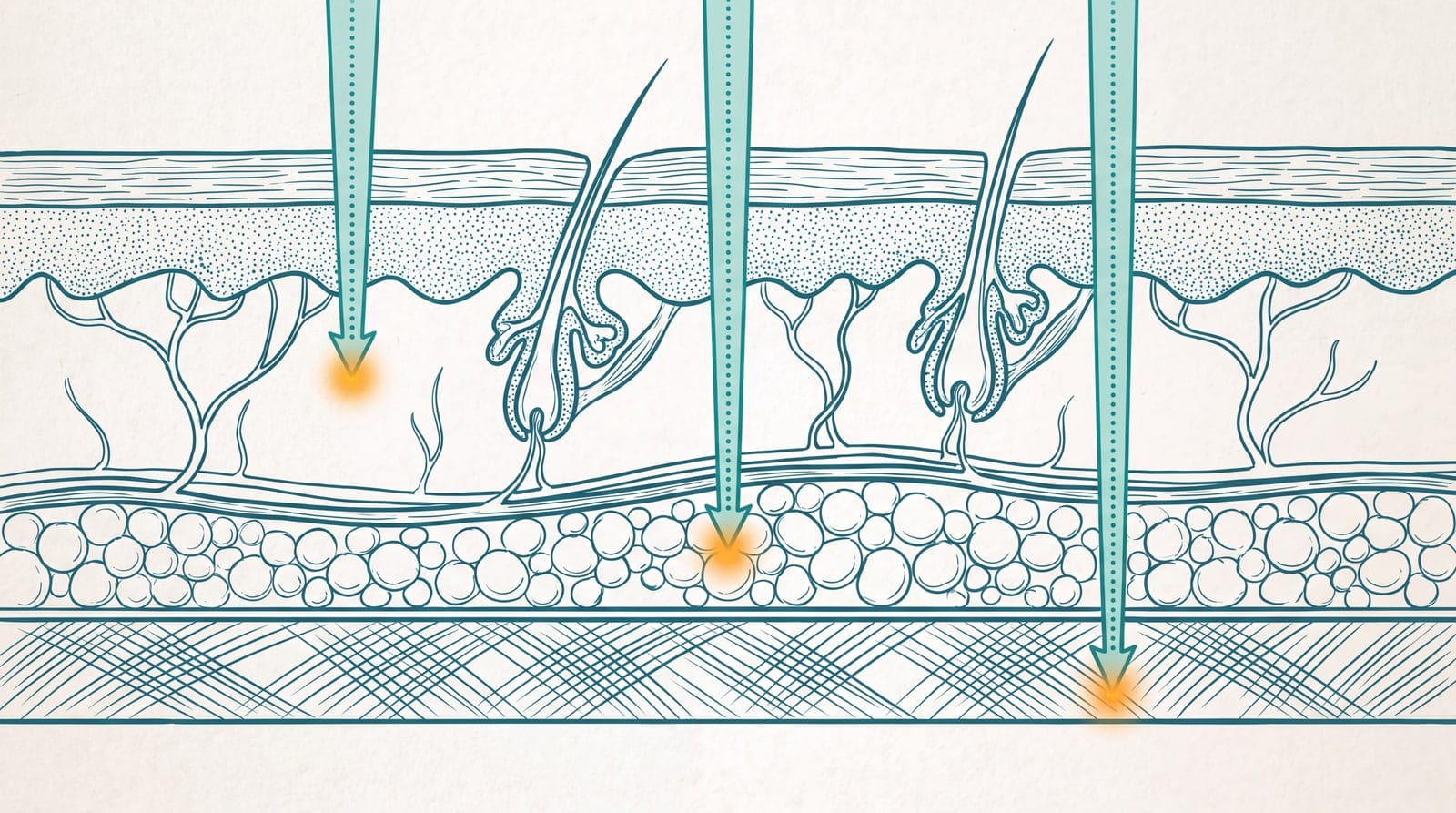
HIFU stands for High-Intensity Focused Ultrasound — concentrating high-frequency sound waves so they focus and pool their power at a "single point" beneath the skin, like using a magnifying glass to gather sunlight into one intense hot spot. That focal point heats up to around 65 degrees Celsius in an instant, making the collagen there contract at that moment and stimulating new collagen production. Its strength is that it can reach deep down to the SMAS layer, the muscular membrane layer that surgeons pull during a facelift — this is why HIFU excels at "lifting." Ulthera and Ultraformer are in this group.
RF (Radiofrequency) — radio waves that spread heat across an area
RF, or radiofrequency, works differently. Instead of focusing on a point, it spreads heat across a wide volume throughout the dermis, gradually warming the tissue to the temperature that stimulates collagen. The result therefore comes out as "skin tightened across the whole surface, smoother, with pores looking more refined" rather than lifting the facial structure as lines. Thermage is the representative of this camp.
HIFU is good at "lifting" (deep, as a point, down to the SMAS layer), while RF is good at "tightening and smoothing" (wide, across the whole surface, at the dermis layer). Neither wins or loses — they simply suit different kinds of problems.
What is Ulthera (Ultherapy) — the original HIFU that "sees" the skin layers
When a patient asks, "Ulthera is HIFU, right?" I answer yes — but let me tell you why it's earned the name "the original" of the field. Ulthera (officially called Ultherapy) is a focused ultrasound device that has been approved by the US FDA since 2009 for brow lifting, and later received additional approval for lifting and tightening under the chin and neck, as well as wrinkles on the upper chest area.
The standout feature that sets Ulthera apart from typical HIFU
What makes Ulthera special is the word "Visualization" (MFU-V) — it has an ultrasound screen that lets the physician actually "see" the skin layers before releasing energy, like having a flashlight to reveal what's beneath the skin at that spot and how deep each layer is. The doctor can therefore place the energy right on target and avoid structures that shouldn't be hit, such as blood vessels or bone. Several research reviews have found that roughly 60–90% of patients see improved tightening of the mid- and lower face at around 6 months after treatment.
Another thing I like to tell patients is that there's a study that measured the skin after Ulthera and found that the upper skin layer was barely disturbed at all — skin water loss values, skin temperature, hydration, and redness did not change significantly, both in the first 3 days and at 24 weeks. This means the energy goes deep to do its work without damaging the upper facial skin. This is why it leaves almost no wound and has little downtime.
What is Thermage — the radiofrequency that tightens and smooths the whole surface
Now that we understand Ulthera, let's get to know Thermage, which is a different camp altogether. Many patients mistakenly think Thermage is just another brand of HIFU — it's not. Thermage uses monopolar RF radiofrequency, not ultrasound. It's a device that delivers heat from radio waves, spreading it down to warm the dermis to around 65 degrees, making collagen contract and rebuild.
What does Thermage excel at
Because RF spreads heat over a wide area, Thermage gives a result of "skin tightened across the whole face, smoother, looking firm and plump" rather than lifting the facial frame as distinct lines. It suits people whose skin is starting to sag in a general way, with thin skin, shallow wrinkles, or who want their skin to be tighter and smoother. Research that followed over 600 treatments with monopolar RF confirms that it is effective and safe for mild to moderate skin sagging, and it's considered one of the standards of non-surgical skin tightening.
Because they complement each other perfectly — HIFU goes deep to "lift" the facial structure, while Thermage helps "tighten and smooth" the upper skin. Some people who have both a sagging face and uneven skin therefore get better results when both are planned together in the right balance. Not everyone needs to do both, but in suitable cases, it's a way for them to complete each other.
What is Ultraformer III — the finely adjustable, easy-to-access HIFU
Now we come to the one patients have asked about the most lately, because it often comes with a more affordable price — Ultraformer III. It's a HIFU device just like Ulthera (also using focused ultrasound), but its selling point is that it has many cartridges (firing tips) of different depths to choose from, from very shallow levels for thin, delicate skin like around the eyes, all the way down to depths reaching the SMAS layer.
Who is Ultraformer III suitable for
Because it has finely graded tips to choose from, I can adjust the plan very flexibly — for example, using shallow tips around the eyes and forehead, deeper tips on the facial frame and under the chin, and it can even treat the body (such as tightening the upper arms or abdomen). Another point I like is that it can fire gently and distribute points densely, making many people feel more comfortable. Overall, Ultraformer III is a good choice for those who want to start preventive lifting, or want good value while still getting the full HIFU principle.
- Ulthera = the original HIFU, with a screen to see the skin layers, precise, excels at lifting
- Thermage = RF radiofrequency, excels at tightening and smoothing the skin across the whole surface
- Ultraformer III = HIFU that adjusts finely between deep and shallow, can treat both the face and body, easy to access
A clear comparison table: Ulthera vs Thermage vs Ultraformer
I've gathered it all into a single table so you can compare easily where each one differs (the price figures are approximate ranges, used as a guide; the actual price must be assessed in person):
| Topic | Ulthera (Ultherapy) | Thermage | Ultraformer III |
|---|---|---|---|
| Type of energy | HIFU (focused ultrasound) + Visualization screen | Monopolar RF radiofrequency | HIFU (focused ultrasound) |
| Reaches down to layer | Deep to the SMAS (1.5–4.5 mm) | Wide at the dermis layer | Deep to the SMAS, multiple tip levels selectable |
| Excels at | Lifting the facial frame, under the chin, brows, precise | Tight, smooth, refined skin across the whole surface | Lifting + fine adjustment, can treat the whole body |
| Suitable for | Sagging facial frame, wanting a clear lift | Skin starting to sag, thin skin, wanting smoothness | Starting preventive lifting, good value |
| Sensation during treatment | A deep pinpoint sting | A flash of heat alternating with cooling | A pinpoint sting, gentler |
| Recovery | Little; slight redness/swelling for 2–3 days | Little; slight redness | Little; slight redness/swelling |
| Results begin | 2–3 months, clearest at ~6 months | 2–3 months, clearest at ~6 months | 2–3 months, clearest at ~6 months |
| Results last | ~12–18 months | ~12–18 months | ~12–18 months |
| Approximate price range | High (low to mid five figures THB) | High (low to mid five figures THB) | More accessible |
So which one should I choose? Choose by your "facial problem," not by the name
Now we come to the question patients most want to know — "So which one should I do, doctor?" Let me answer straight: there's no single best one for everyone, only the one that suits "your problem." So I want you to look at your own facial problem first, then match it to a device.
If the problem is "sagging" → think HIFU first
- The facial frame is starting to blur, not as defined as before
- Cheeks dropping, the area under the chin sagging, a double chin starting to form
- The tail of the brow / corner of the eye starting to droop
- Wanting to "lift" the facial structure to look firmer
If the problem is "skin not smooth / not tight" → think RF (Thermage)
- Skin starting to sag generally, thin skin
- Shallow wrinkles, skin looking tired and not bouncy
- Wanting the skin to be tighter and smoother across the whole face
- Pores looking large, wanting them to look more refined
And if you have both problems mixed together (which is very common), planning to do both HIFU and RF to complement each other often gives a more natural and complete result. There is research that combined HIFU with monopolar RF and found that most patients tightened up clearly — but this doesn't mean everyone has to do both. It depends on what your face truly needs, which requires a physician's assessment first.
If the face sags so much that the skin is left in folds, or there's a large, obvious double chin, lifting devices can help "to a degree" but not as much as a surgical facelift. I always tell you straight how much the device can help, because I don't want you to spend money on unrealistic expectations. Assessing the actual face first is therefore more important than looking at other people's reviews, because everyone's face is different.
Does it hurt? How many days of recovery — every step told honestly
I understand this is what many people worry about most. Some have wanted to do it for a long time but were afraid of the pain and never dared. Let me tell you honestly, without selling dreams.
During the treatment, there's a warm, deep, pinpoint sting in rhythm as the device releases energy. For HIFU (Ulthera/Ultraformer), you feel a deep pinpoint sting during the firing, while with Thermage you feel a flash of heat with a cooling system alternating in intervals. The level of sensation depends on the depth being fired and each person's sensitivity. Most people tolerate it comfortably and don't need general anesthesia. The newer devices also have systems to make it more comfortable, and I adjust the energy level to match what you can handle.
What is it like afterward, is the recovery long
- The first day — there may be slight redness, swelling, or a dull, tender feeling at the treated area, but you can put on makeup and go home, and live life as normal right away
- The first 2–3 days — the redness/swelling gradually subsides; some people feel a bit tight, which is normal
- 1–2 weeks — the discomfort is completely gone; the skin enters the phase of beginning to build new collagen
- 2–3 months — the tightening result starts to become increasingly visible
You can see that the strength of this group is almost no downtime — no wound, no need to take time off work, finish and go straight back to life. This differs from surgery, which requires weeks of recovery.
How many days until results, how long they last (and why it's not permanent)
This question is very important, because if you misunderstand it, you'll be disappointed for nothing. Let me emphasize — this group of lifting devices does not show results that transform the face in a single day, and they're not permanent, because their principle is to "stimulate the body to build new collagen," which the body needs time to do at its own pace.
In the early period after treatment, many people feel their face looks slightly firmer from the existing collagen contracting, but the "real result" gradually becomes clearer over 2–3 months as new collagen is built, and continues to improve up to around 6 months. After that, the result usually lasts about 12–18 months, depending on age, skin condition, and self-care. When the time comes that collagen gradually declines with age, many people therefore choose to repeat once a year to maintain the result.
I'd like you to see it as "a continuous investment in skin care" rather than "a one-time fix-it-and-you're-done." Because time keeps moving and our skin keeps aging every day, consistent care gives a more lasting result than expecting a miracle from a single session.
What's the price range, how is it calculated, and why each place differs
Price is what patients find most confusing, because a search turns up everything from thousands to hundreds of thousands of baht. Let me explain how it's calculated, so you can read prices wisely and not get fooled.
What is the price calculated from
- The number of "shots" or "lines" fired — this is the main price factor for HIFU. The more shots fired, covering a larger area, the higher the price. Beware of abnormally cheap promotions that may fire too few shots to produce a visible result
- The device model and authenticity — a genuine, certified brand-name device with genuine firing tips costs more than imitation devices or fake tips, so prices differ greatly
- The area being treated — treating only under the chin differs from treating the whole face + neck
- The experience of the physician performing it — someone who can read anatomy and place energy accurately is what you're really paying for
If you find a price far cheaper than the market, ask straight out, "How many shots are fired, which device model, are the tips genuine, who does the firing?" Because with this group of treatments, if it's abnormally cheap, there's usually something hidden — perhaps too few shots to see results, fake tips, or someone who isn't a physician doing the firing. You pay cheap but get no result or take a risk, and in the end it costs more than before. A straightforward clinic is always glad to tell you everything before treatment.
At de Pry Clinic, Dr. Time gives the honest price according to the plan that suits your face, with no pushing of course packages, and we always discuss clearly beforehand what will be done, how many shots, and what result to expect. If you want to know the price that truly fits your face, message in to let me assess first — the consultation is free.
Safety — why "who performs it" matters more than the device's name
I've saved this topic for last because it's the heart of what I want everyone to remember when deciding — this group of lifting devices is highly safe when done correctly. Common symptoms like redness, swelling, and tenderness usually resolve on their own within 2–3 days.
But what I'm concerned about are the risks that are "preventable" if the operator truly knows their craft. Because the heat energy goes deep, if the settings are unsuitable or fired in the wrong position, there can be superficial burns, or if fired along a nerve line, there can be temporary numbness or muscle weakness. These risks almost never occur when in the hands of someone who knows facial anatomy and can control the energy.
This is exactly why I emphasize that "who performs it" matters more than "what the device is called." Because the very same device, in the hands of someone who can read the skin layers versus someone who fires by a fixed formula, gives results and safety that are worlds apart. The physician caring for you must know where it's safe to fire deep, where to watch out for nerves, and where to go gently — this knowledge is what truly protects your face.
Consult about skin lifting in Phitsanulok — de Pry Clinic
If you're in Phitsanulok or a nearby province and you're hesitating over whether to do Ulthera, Thermage, or Ultraformer, I want you to know you don't have to travel all the way to Bangkok. At de Pry Clinic, Dr. Time personally assesses and plans the lifting for every case, looking at your actual face, listening to your concerns, and choosing the device and depth that truly suit your problem — not promoting whatever device the clinic happens to have.
Many patients travel from Phichit, Sukhothai, Uttaradit, Kamphaeng Phet, and Phetchabun because they want care from a real physician somewhere close to home, without wasting time on long journeys. I'm committed to bringing back the knowledge and techniques of skin care to look after people around here, so they receive good care close to home.
I want you to feel at ease that, whether you choose to do it or not, I'm always happy to give honest advice — I can tell you what suits your face, how much the device can help, and what the price is, with no pushing. Message in to talk with Dr. Time anytime — the consultation is free, at no charge.
Frequently Asked Questions
How are Ulthera and Ultraformer different? Are they both HIFU?
Both are genuine ultrasound lifting devices, but they're not the same one. Ulthera (Ultherapy) is the original, approved by the US FDA for lifting and tightening, with the standout feature of an ultrasound screen that lets the physician "see" the skin layers before firing energy (called MFU-V). Ultraformer III is another HIFU device that has many firing tips of different depths to choose from, allowing fine adjustment, treating both the face and the body, with a more accessible price. Choosing between the two depends on your skin problem, budget, and the plan the physician assesses for each person.
How does Thermage differ from HIFU (Ulthera/Ultraformer)?
The difference is in the "type of energy" and the "layer it works at." Thermage uses radiofrequency (RF) to spread heat across a wide area at the dermis layer, so it excels at making the skin "tighter, smoother, and more refined" across the whole surface, suiting skin that's starting to sag and thin skin. HIFU, on the other hand, fires energy as a focal point deep down to the SMAS layer (the same layer surgeons pull during a facelift), so it excels at "lifting and tightening" a sagging facial structure. Many people who have both problems therefore do both devices to complement each other.
Does lifting with Ulthera/Thermage/Ultraformer hurt?
There's a warm, deep, pinpoint sting when the energy is released. The level of sensation differs by device and the depth being fired. Generally, HIFU (Ulthera/Ultraformer) feels like a deep pinpoint sting at the moment of firing, while Thermage feels like a flash of heat alternating with cooling in intervals. Today's newer devices have systems to reduce discomfort, and the physician can adjust the energy level to match each person. Most people tolerate it comfortably and don't need general anesthesia.
How many days until results show, and how long do they last?
The heat-energy lifting group shows results gradually, because the principle is to stimulate the skin to build new collagen. In the early period after treatment, many people feel their face looks slightly firmer from the skin tightening, then the real result becomes increasingly clear over 2–3 months and continues to improve up to around 6 months. Overall the results usually last about 12–18 months, depending on age, skin condition, and self-care — it's not a one-time treatment that lasts forever.
At what age should I start? Is it too early?
There's no fixed number — look at "skin condition" rather than the age figure. People who are starting to see the facial frame blur, cheeks beginning to sag, folds deepening, or skin starting to lose its bounce usually do well with preventive lifting. As for those who sag so much that the skin is left in folds, lifting devices may help to a degree but not as much as surgery, so I must always assess the actual face first to tell you honestly how much the device can help.
What are the side effects or risks?
The common, self-resolving ones are slight redness, swelling, tenderness, or a dull feeling at the treated area for 2–3 days. Some people have redness or swelling lasting a bit longer. The ones to watch out for, which are uncommon, are superficial burns if the energy is set unsuitably, or temporary numbness/muscle weakness if a nerve is hit. These risks are greatly reduced when done with a physician who knows anatomy and can control the energy, rather than firing by a fixed formula.
Can a lifting device replace filler injections or thread lifts?
They have different jobs. Lifting devices (HIFU/RF) work on "tightening and building collagen," while filler adds "volume" that has been lost, and thread lifts help "prop up and pull" the facial structure mechanically. Many cases that turn out beautiful and natural come from planning a combination of several things to fit the real problem, rather than hoping any one of them can solve everything. That's why I emphasize assessing first what your face truly needs.
Can I get lifting treatments in Phitsanulok, or do I have to go to Bangkok?
You don't have to go to Bangkok. At de Pry Clinic, Phitsanulok, Dr. Time personally handles the assessment and lifting plan for every case, choosing the device and depth to suit each person's face. Many patients travel from Phichit, Sukhothai, Uttaradit, Kamphaeng Phet, and Phetchabun because they get care from a real physician close to home. You can always consult first — no need to rush a decision.
References and verification
I'd like you to be able to verify the information I used to write this article yourself — click to read the originals:
- PubMed Central — a research review concluding that focused ultrasound (HIFU/MFU, like Ulthera) genuinely tightens and rejuvenates the skin, with roughly 60–90% of patients seeing results at ~6 months: pmc.ncbi.nlm.nih.gov
- PubMed — research following over 600 treatments with monopolar RF radiofrequency (like Thermage), confirming efficacy and safety for mild-to-moderate skin sagging: pubmed.ncbi.nlm.nih.gov
- PubMed — a systematic review on HIFU for skin lifting/tightening and body contouring, compiling evidence on safety and outcomes: pubmed.ncbi.nlm.nih.gov
- Cleveland Clinic — consumer-side information on radiofrequency (RF) skin tightening: mechanism, benefits, and cautions: my.clevelandclinic.org
- PubMed Central — research combining HIFU with monopolar RF to tighten the skin, finding that most patients tightened up clearly (evidence for "doing two devices to complement each other"): ncbi.nlm.nih.gov
Written by
ดร.นพ.ณธธรรมภ์ โอภาอภิณัฐฏ์ (หมอธามน์)Clinic physician at de Pry Clinic, Phitsanulok · Thai medical license no. 56524